


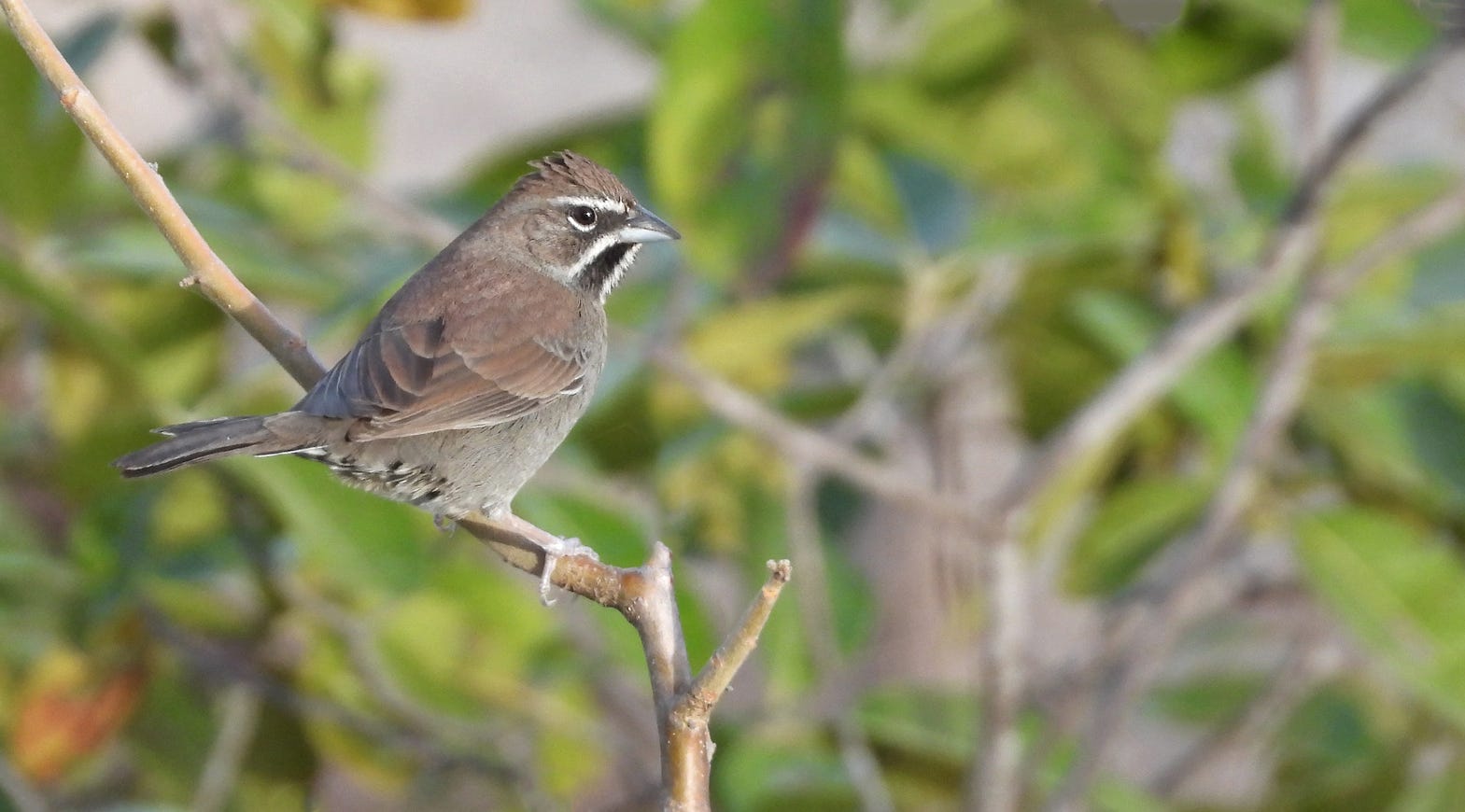
ALTHOUGH it has achieved a kind of celebrity status among birdwatchers, let’s be honest about the Five-striped Sparrow: it’s no bird-of-paradise. Brown and sooty, the sparrow is named for five white stripes that fan out across its face and throat — an arrangement not particularly unusual among sparrows. Its song, a progression of tepid “dinks” and “chips,” sounds as if the Five-striped Sparrow can’t quite decide whether to sing out for a mate.
Even so, we birders go to great lengths to see this sparrow. It begins with a flight to Arizona, where we rent SUVs because roads to the sparrow can be rough and rutted. We then drive south toward Mexico, toward Sycamore Canyon or California Gulch, which are among the few reliable places to find Five-striped Sparrow north of the border. And there among the mesquite and the rattlesnakes, we begin our quest. Stereotypes clad in khaki and toting binoculars, we drive the dirt in search of a little brown bird.
And once we finally locate a Five-striped Sparrow, skulking in some thicket, we might chase it around a bit, peer at it through binoculars, study its antics, snap photos, and slap high-fives. We then turn and drive out, northbound toward the cantinas and coffee joints to celebrate and plan for the next day’s birdwatching adventure.
But the problem with Five-striped Sparrow is not its muted plumage or feeble song, not its furtive behavior or unforgiving habitat. The problem is that through no fault of its own the Five-striped Sparrow is bad for the planet. In our hot pursuit of this rarity, birdwatchers drive — we drive a lot. If a songbird could express a carbon footprint, the Five-striped Sparrow would be a tiny coal-fired power plant.
Birdwatching’s dirty little secret is that in our enjoyment of nature we birders warm the planet. Even as we go electric on the road, petroleum nevertheless fuels our adventures. To be sure, we are not alone in this regard; lots of people drive to work, to the doctor, to drink microbrews, to play outdoors. Most of us board flights for vacations and to visit faraway family. We’re prosperous — we burn stuff.
And yet birdwatchers, especially this time of year, have an unusual dependence on our vehicles. Our cars, trucks, and SUVs are often foundational to how we discover and enjoy birds anywhere. Birders probably drive more in the pursuit of nature than do botanists, hikers, hunters, mountain bikers, or most other people who recreate outdoors. What’s troubling about this is that birdwatchers cultivate a certain ethos about our pursuits: that we’re unlike snowmobilers or ATVers or other people who partake in “consumptive” forms of recreation. We make the case that birds are a gateway to nature and that watching them builds a conservation ethic, which is ultimately good for the planet. A lot of this is even true.
And by no means do I intend to put on trial well-meaning birders or anyone else with similar passions for wildlife and wild places, which is pretty much all of us. Birdwatching is good for the world. Except that right now tens of thousands of birdwatchers are on the verge of some serious carbon-burning.
Holiday “Bird-Driving”
We birders and our organizations go on at great length about the climate crisis and various eco-disasters. The National Audubon Society issues ample warnings about rising global temperatures and a corresponding decline in birds or a shift in their patterns of distribution. We’re told of “389 Bird Species on the Brink”1 or that climate change is “the single greatest threat to birds and other species”2 or that “10 States Could Lose State Birds.”3
To be sure, the reports and admonitions are warranted; Audubon and the rest of us need to keep pressing on climate, including calling out and voting out climate deniers and demagogues. Even so, as it calls us to action, Audubon every year encourages birdwatchers to undertake an epidemic of binge-driving. The annual Christmas Bird Count is a storied citizen science project. Around the winter holidays, birdwatchers fan out to count every bird we encounter within established, 15-mile-diameter circles — nearly 2,700 of them scattered mostly across the Western Hemisphere. For 125 years, birders have been participating in these one-day counts, during which we gather valuable data on bird population trends. The Christmas count is a triumph of participatory science (even if it needs a new name).
But the Christmas count is also a group exercise in burning carbon. It basically goes like this: drive around, stop the car, get out and count birds, maybe walk a bit, write down your tally, get back in the car, repeat all day long. A friend of mine calls this “bird-driving.” Most birdwatchers on Christmas counts drive far more than they walk. Many walk less than a mile or two over the course of the day, and drive 10 or 20 times what they walk.
Even though these counts aren’t year-round affairs, birdwatchers undertake other specialty expeditions that mirror the Five-striped Sparrow quest — only with more driving. In Kansas, Nebraska and Colorado, for example, a well-established route brings us to at least five species of grouse performing outrageous mating displays in early spring. Birders who make the trip not only get to see the chicken-like birds dancing and strutting and sometimes copulating in some of the most bizarre and wonderful rituals in North American birding, we also get to add the five species4 to our life lists — the ongoing tally of all the birds we’ve ever seen. But finding the grouse necessitates some serious bird-driving, 2,000 miles or more over the course of a week and a half.
Birders make all kinds of crazy trips like these, including spur-of-the-moment outings when a rare bird turns up closer to home — or far away. The internet helps set our travel plans, thanks in part to the esteemed Cornell Laboratory of Ornithology. In addition to being the most important tool for aggregating crowd-sourced data on bird distribution and abundance, Cornell’s eBird platform issues email alerts5 about rare birds anywhere they’re reported. So if, say, a Eurasian Skylark shows up in British Columbia or a Masked Booby lands in Florida, we can hear about it on the hour. A subset of determined birders uses these alerts to hop in the car or board a flight to pursue far-flung rarities.
While visiting family vacationing in Florida about 30 years ago, before eBird existed, I was fortunate to dwell in a park with a Bananaquit, a frenetic slate-and-yellow songbird that had strayed from its normal turf across Central America, South America, and the Caribbean. As I watched the Bananaquit flit in the low branches of a leafy tree, three birders from New Jersey pulled in. They had driven all night, part of it through a snowstorm, to reach the spot. We watched the Bananaquit together for about 20 minutes. Then, having ticked the songbird for their lists, the birders piled back into the car and headed for home.
I should point out that most birdwatchers are not so obsessive. Nearly 100 million of us watch birds in North America.6 We range from the hard-core few chasing rarities to the homebound enjoying whatever’s at the backyard feeders. Many of us, privileged and a bit nerdy or odd, are worthy prey in a tradition of satire. And yet for our shared devotion to birds and their fate, for our bond with nature, I remain proud and wholly supportive. Passion for anything in nature is an enduring and essential human trait, not unlike our passion for art or literature or one another, and far more genuine than most of what’s online or conjured up and packaged for popular consumption. No wild things in nature — not orchids or butterflies or trees — command so much organized devotion as do birds. And that is a very good thing.
Captured by Carbon
But devotion to nature, however well-intentioned, is a poor excuse for excessive consumption, which, after all, is killing the planet. The author Jonathan Franzen, a birdwatcher himself, poked at this question some time ago in a New Yorker essay titled “Carbon Capture.”7 Franzen first admits to guilt about driving and listing birds. Then in no short order he picks a fight with Audubon, accusing it of a fixation on global warming’s threat to birds. As it turns out, birds face multitudes of risks more problematic than a warming planet, including death by house cat, window strikes, lead shot, invasive species, pesticides, and, most importantly, outright habitat degradation and destruction, mostly for agriculture. Anyone who’s been watching birds for 30, 40, 50 years or more, as I have, has witnessed the disaster in real time: fewer birds, largely for reasons having little or nothing to do with climate.
Franzen’s point is that emphasizing the climate threat, including our personal fuel consumption, although worthy, amounts to guilt-tripping and distraction. Not only does it shift blame and burden to us, who as individuals are all but powerless when it comes to achieving appreciable greenhouse gas reductions, it won’t do much to help birds. “Although you could demonstrably save the lives of the birds now colliding with your windows or being killed by your cats, reducing your carbon footprint even to zero saves nothing,” he writes. “Declaring climate change bad for birds is therefore the opposite of controversial. … Climate change is everyone’s fault — in other words, no one’s. We can all feel good about deploring it.”
More practical and important, Franzen points out, is protecting as much habitat as possible so that birds have refuge from deforestation, industrial agriculture, and other proximate ecological disasters. “To prevent extinctions in the future, it’s not enough to curb our carbon emissions,” he writes. “We also have to keep a whole lot of wild birds alive right now. We need to combat the extinctions that are threatened in the present, work to reduce the many hazards that are decimating North American bird populations, and invest in large-scale, intelligently conceived conservation efforts, particularly those designed to allow for climate change.”
Franzen is among our most brutally authentic voices at the intersection of birds, nature, and the rest of us. And he’s right about the futility of personal action on climate. Absent genuine political leadership or more effective mass movement, carbon reduction on the part of any individual is noble and yet feeble. It’s the right thing to do, it inspires others, but it won’t save many birds. Franzen drew unwarranted opprobrium from the birding establishment for “Carbon Capture,” even as he accepted climate change’s “supremacy as the environmental issue of our time.” I welcomed his essay. Still, he might have reckoned a bit more with driving.
Petroleum enriches lives and destroys lives. To keep the crude flowing, the U.S. government — under Democrat and Republican alike — has sponsored despots, bombed nations, killed innocent people, and spoiled places abroad and at home. The fossil fuels that bring us prosperity, safety, comfort, and Five-striped Sparrows come by way of human and ecological abuses from the Niger Delta to the Persian Gulf, from the tar sands of Canada to the fracking lands of the U.S. For better and for worse, our culture and economy are founded on cheap goods, abused land, exploited labor, and crude oil. Blood and oil — they have always flowed together.
Granted, for most of us, to live is to cause harm or injustice somewhere, whether we buy gadgets or sweat-shop jeans, eat livestock or drink coffee, buy gasoline or burn firewood. As a field biologist focusing on birds and insects, I live in a tiny space of 464 square feet, but work and play (and often live out of) a gas-guzzling Toyota pickup. Most of us are perpetrators or victims or both on a warming planet.
Franzen’s essay, now a decade old, has aged well through failed COP meetings on climate and into Donald Trump’s second round of eco-malevolence. Market forces are now driving power generation increasingly toward wind and solar (even as heat pumps and electric vehicles in the U.S. still run on electricity generated more from fossil fuels than from renewables). To be sure, greenhouse gas emissions increasingly threaten birds and other wildlife, especially butterflies and other insects, and, most profoundly, ocean life. Still, Franzen’s essay holds. The greatest threats to birds include:8
Habitat loss or degradation owing to agriculture, deforestation, urbanization, and suburban sprawl.
Domestic and feral cats (which kill birds by the billions every year) and invasive plant and animal species (especially rats and pigs on oceanic islands).
Windows strikes, vehicle collisions, and agricultural pesticides and other poisons.
Bycatch of albatrosses, petrels, and other seabirds during commercial fishing.
Climate change certainly matters, and exacerbates these threats. Every fraction of a degree of heating avoided makes a difference, especially for human well-being. But when it comes to individual acts, however symbolic, doing right by birds is probably more a matter of what we eat than how much we drive.
Walk More, See More
Birdwatching’s carbon problem is of course about more than carbon — or even birdwatching for that matter. It’s about how any of us live in and relate to an increasingly unnatural world. Another dirty secret about birders is that too many of us have lost our fondness for the familiar. Perhaps more than any other breed of nature geek, birders sometimes exhibit a benevolent disregard for what’s in front of us and an obsession with what’s next. Sure, the Ruby-crowned Kinglet is fine, but we gotta drive on to find the rare Violet-crowned Hummingbird. Too many birders simply click-like the kinglet and move on to what’s next. We’ve been doing this long before the internet addled our brains for impatience.
I have chased more than my share of rare birds in vehicles, including as a birdwatching guide finding Five-striped Sparrows and other rarities in Arizona. I gave it up years ago (including the extra sparrow driving) for more time with nature closer to home — and for more walking. Bird-walking. Most of the time, on my outings here in Vermont, I do not find the rarities that motivate many other birdwatchers. So be it. I accept what comes. That Ruby-crowned Kinglet sings with vigor and sends a bolt of energy toward his crown, from which ruby feathers erupt like little flames. Too many birders fixated on what’s next have never seen these fireworks (which will never erupt anywhere from a Five-striped Sparrow).
Shall we keep on birding, driving, and sending donations to the Cornell Lab, American Bird Conservancy, Audubon, and our local eco-groups? Of course. We might also buy less stuff, board fewer airplanes, eat less meat, drink fair-trade coffee, drive electric vehicles, install heat pumps, watch birds closer to home, and partake in eco-travel with authentic carbon offsets and real benefits to people living in our destinations. We can support landscape-level conservation projects. We can vote out the demagogues, liars, and retrogrades.
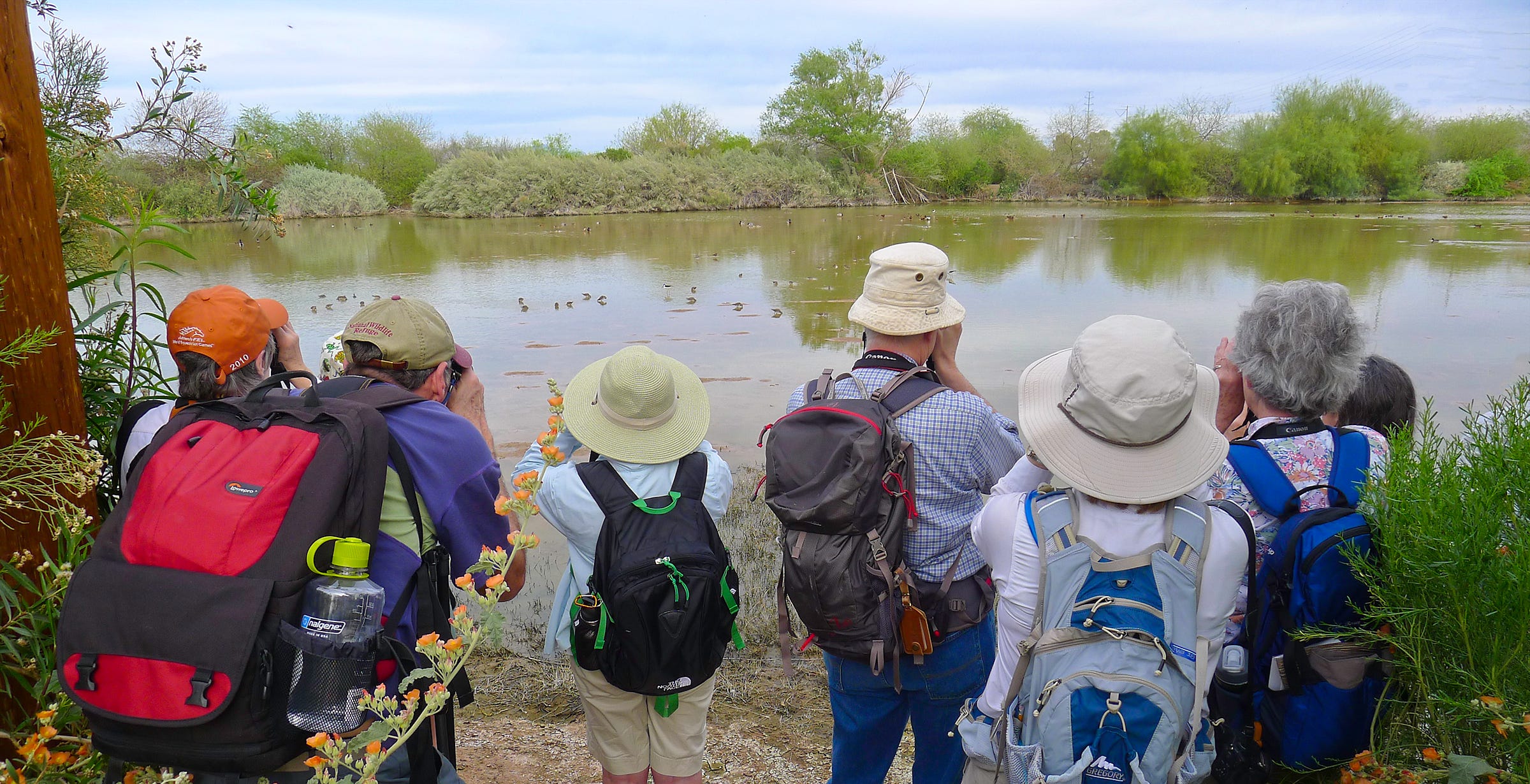
And we can continue counting birds, even driving for them, this holiday season. But at the very least, if you are able, try to walk more than you drive during a bird count, or at least walk more than a mile or so. (If walking isn’t an option due to a disability or some other reason, Birdability might help.) My own Christmas Bird Count route where I live is a 4.5-mile walking loop featuring zero miles of bird-driving.
In the end, when it comes to carbon and consumption, there’s little new here among our obligations as citizens, whether we join mass movements or act alone. Apart from that, I know of no reliable path through this moral thicket — other than to walk. I walk in nature even as hope for wildlife and wild places seems elusive. I walk in nature because equanimity everywhere else can be elusive. And I walk in nature so that I might love myself, love the world, and do what I can to make it a better place.
And then do even more.


Postscripts
An exemplary landscape-level conservation project is the Guanacaste Dry Forest Conservation Fund (GDFCF). Check it out and donate money.
Read more Franzen essays in “The End of the End of the Earth.”
Bill Davison, who writes Easy By Nature here on Substack, expresses beautifully the virtues of watching birds in an essay that went viral.
Jason Anthony, who writes Field Guide to the Anthropocene, is a studious and searing voice on our place on an abused planet.
This essay was written and revised (many times) by a human being — not A.I.
https://www.audubon.org/climate/survivalbydegrees
https://www.audubon.org/our-work/climate
https://climate2014.audubon.org/article/9-state-birds-may-abandon-homes-thanks-climate-change
Greater Sage-Grouse, Gunnison Sage-Grouse, Sharp-tailed Grouse, Greater Prairie-Chicken and Lesser Prairie-Chicken
https://ebird.org/alerts
https://www.fws.gov/story/2024-12/birdwatching-america
https://www.newyorker.com/magazine/2015/04/06/carbon-capture
https://www.birdlife.org/papers-reports/state-of-the-worlds-birds-2022/

Again, thank you. I do enjoy nature nearby. Less pain, more gain. My cats are indoor cats. My gardens are mostly native plants. My woodlot is in permanent protection from development with a management plan for carbon sequestration and biological diversity of native species. With my forester I am adding to the woodlot maps locations of special habitats and species locations (old trees, outcrops, seeps, etc). I do drive my car, I hike on and off trail. We do what we can. Education, outreach, enjoying community and nature, as well as modeling best practices can help the planet. Just as you say.
I think a lot of this is driven by our anxiety and helplessness at climate change.
While we should not ignore our personal impact, power and Industry emit 60% of carbon and ground transportation emits 18%... we should reduce our usage while we continue to push for greater change. Conservation Works suggested that the large environmental groups and conservancies who collect millions in donations by fearmongering and offering inadequate responses need to change their tack to be more effective, and I agree.
But it wouldn't hurt if Audubon challenged birders to walk and bike instead of driving!