
Lichen Incognita
The virtues of spending two years watching something in nature do basically nothing

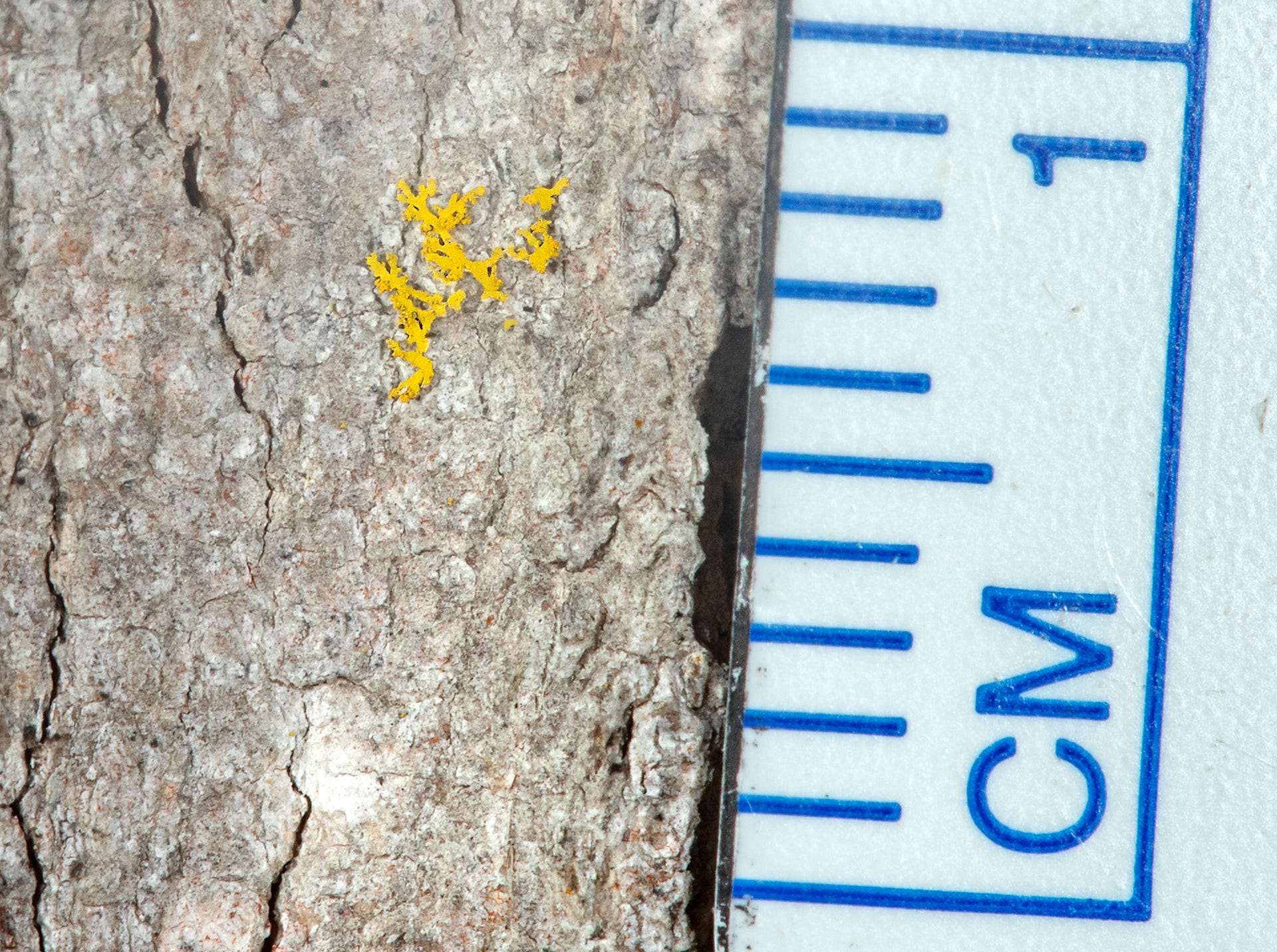
BEFORE I explore a big idea expressed in a tiny patch of yellow on tree bark, let’s first agree on this: a lichen is a metaphor machine.
It would be easy for me in this essay, for example, to go with symbiosis. That’s because a lichen is a collaboration — a union of a fungus and a photosynthetic partner. I’d go on to point out that the Candleflame Lichen (Candelaria concolor) pictured above would not exist without symbiosis. Neither would any one of us.
Another easy metaphor would be change. After all, for two years I’ve been watching this minuscule patch of lichen grow. And I can now confidently report that you’ll find more excitement watching grass grow or paint dry (and certainly now by watching a glacier melt).
But I have yet another metaphor for you, which I’ll get to soon enough. For now, let’s stick with change.
That I even noticed this nano-patch of lichen two years ago is unusual enough. Although it can splatter-paint tree trunks yellow around the world, this was the only Candleflame Lichen I had ever encountered in woods I’d been walking for a decade or so. Perhaps it had twinkled in the clear, angled light of January on a good day for me and the lichen. Or maybe I happened to be tuned more so to tiny things that afternoon — really tiny things. Even though I know its exact tree, a Sugar Maple, on many days I strained to relocate the lichen on its bark in front of my nose.
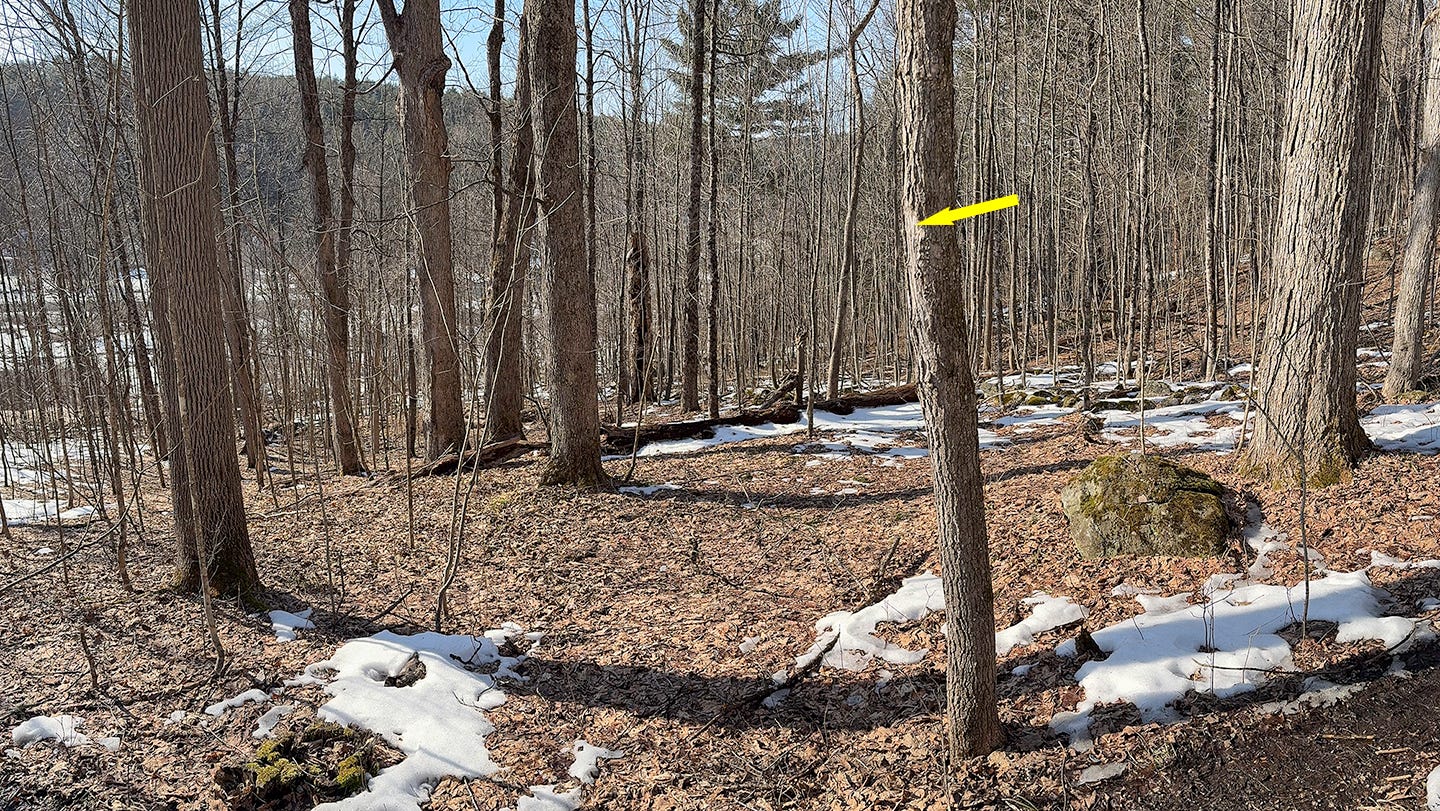
It is no secret that lichens grow ever so slowly. But how slowly? Although I could have chosen a patch more suitable (bigger) for measurement, this one became my “study site.” I set out to watch this lichen change over time.
The world of course changed a lot during those two years — you need not hear details from me. Our politics and culture move even faster, distract more often, and break nearly everything. The lichen moved nowhere, distracted no one (except me), and kept itself mostly unbroken. I liked that about the lichen.
It also grew. I won’t bore you with scientific rigor here — because there was none: No null hypothesis. No established or randomized sampling dates. No time-lapse photography. Quite simply, N = 2: before and after photos spanning two years, a period including a year of Joe Biden and a year of Donald Trump.
Accordingly, by my measurements, the lichen grew … spoiler alert … a little. Documenting it required only macrophotography. I’ve marked two of the most obvious growth spots in side-by-side images below (with the eye of a needle in 2024 as our measuring gauge).
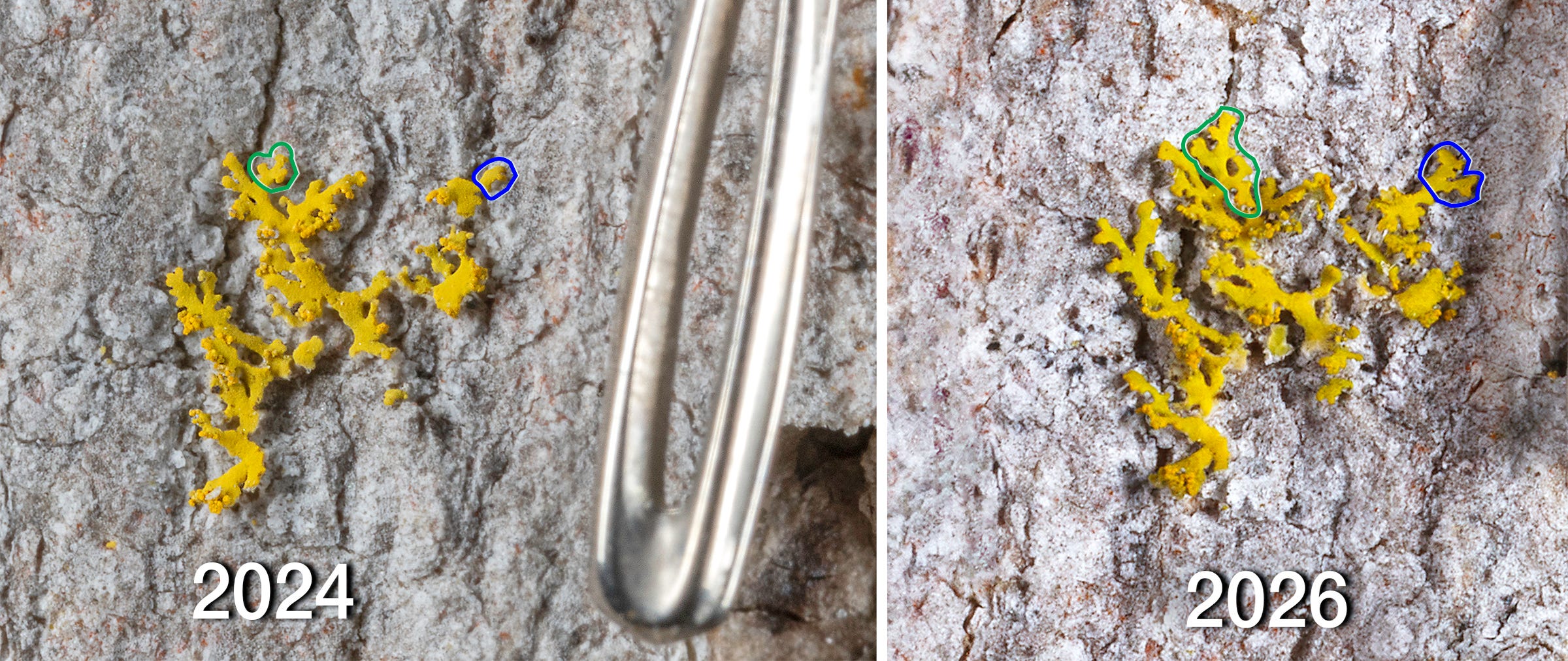
So what’s the point of all this? Well, at the very least, in two years of growth and change in our culture, some of it wonderful, some of it horrible, and so much of it turbulent, the lichen didn’t do much of anything. It endured. It remained in repose. I liked that as well about the lichen. It’s one reason I walked to it day after day.
Which brings me to this essay’s coda: Destination. Actually, something more than destination. Until I noticed it two years ago, nobody else in the world had ever seen this lichen (or so I can assume). It rested at about eye-level on a maple beside a path in Montpelier, the capital city of Vermont. And yet it was mine— all mine. It still is. And nobody else’s.
Destination need not be great or sublime, iconic or wondrous as, say, the Grand Canyon, the Eiffel Tower, or the Pyramids of Egypt. It can also be the prosaic just off the beaten path. Nature is a million destinations never experienced by anyone, except perhaps you: a Promethea cocoon on an ash branch, a place where no one else has ever sat in the woods, a monkey-faced bud scar on a Butternut twig, a tiny patch of Candleflame Lichen. Your terra incognita — anywhere.
We live in the epoch of the infinite — the scroll, the feed, the playlist, the possibilities, the 24-hour grudge cycle. My patch of Candleflame Lichen is finite. In this era of upheaval, it is balance. And when I’m feeling lost, the lichen is destination.
So when the world spins much too fast, which is basically always, get yourself to the long, green path, no matter how well-trodden. Find your destination. Make it yours. Visit often.
This essay was conceived and written by a human being (me) — and not AI.
For Paying Subscribers
This patch of lichen makes an appearance in my essay and buyer’s guide on hand lenses (sometimes called jeweler’s loupes) — your portal to new worlds. I never leave home without my lens. The post is behind the paywall, but open by way of gratitude to Chasing Nature’s paying subscribers.
The Kingdom of Tiny Things

Despite our immense and overwhelming presence here on Planet Earth, or maybe because of it, we humans seem universally drawn to things bigger than ourselves. Whales. The Grand Canyon. Giant Sequoias. Rainbows. The Heavens.
Postscript
That a lichen might be “do basically nothing” is license on my part. Lichens (their algal or cyanobacterial participants) photosynthesize, in part to provide nutrients for the fungal partner. Lichens can break down their substrates (even rock) and aid in soil formation. They’re essential food for a few animals. They’re sensitive to air pollutants, making them indicators of air quality. And similar to counting growth rings in trees, lichen growth on exposed rock can be used to determine the date the rock emerged from under ice, soil, or some other cover — it’s called Lichenometry.
Gratitude to my dear friend and colleague Josh Lincoln for lending me his 65mm macro lens for the lichen images.


Unbeknownst to me this is exactly what I needed this morning. Thank you for noticing the persistent beauty of small things.
"Late in life I have come on fern
Now lichens are due to have their turn"
Robert Frost in "Leaves Compared with Flowers"
1936