
The Extinction of Integrity
An endangered whale, fossil fuels, and our imperiled national identity

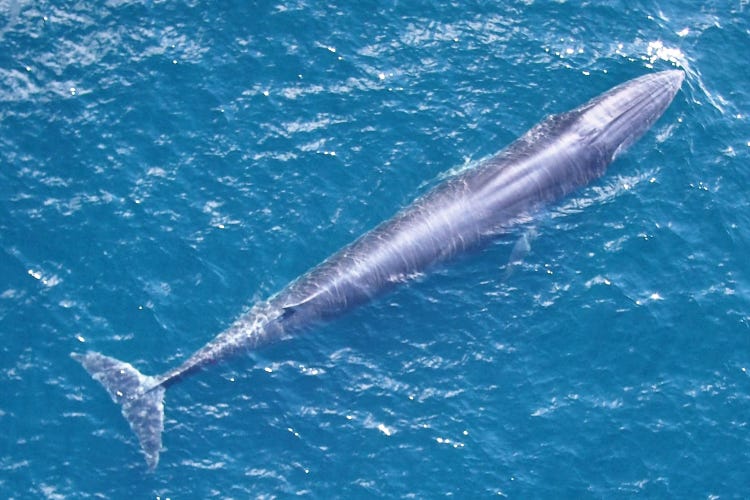
A whale defies intuition. It is vast yet ethereal, slow yet powerful, eerie yet enchanting. A whale is a sublime dream come true.
Sleek and elegant, metallic gray with a pinkish belly, the Rice’s Whale is one of the most endangered whales on Earth. But unlike any dream, this whale could soon become an unwitting test case of morality, extinction, and political power in America.
Having already granted the Rice’s Whale (Balaenoptera ricei) necessary protection in 2019, the U.S. government is now poised to take it away — not because the Rice’s Whale is safe, not because it threatens anyone or anything, but rather because of the Trump administration’s fixation on fossil fuels.
The Department of the Interior next week intends to convene a rare meeting of the so-called “God Squad,” which has the authority to revoke protections afforded to endangered species. The committee’s stated objective is to foster oil and gas exploration and development in the Gulf of Mexico, whose waters are home to the last 50 or so Rice’s Whales in the world.
What’s unusual about this is not only that the God Squad is meeting for the first time in more than three decades. Even more remarkable is that we can watch the machinery of the Rice’s Whale’s potential demise when the God Squad’s meeting is live-streamed on YouTube on Tuesday, March 31, at 9:30 am Eastern Daylight Time (1:30 pm UTC). (Link in postscript.)
Endangered Morality
Monumental and profound, whales should be easy — an open-book test of the human bond to the natural world. To disregard a whale is to spurn the sublime, to scoff at our dreams. But let’s be honest: Many other imperiled species are too often abstractions lacking the whale’s cachet. We don’t revere them in the same way, or know them as we know our pets or backyard birds or favorite wildflowers. Even though I’m reluctant to rank or compare, the Rice’s Whale has a lot more going for it than, say, the Devils Hole Pupfish or the Furbish’s Lousewort. Few of us are in the streets shouting “Save the Pupfish!”
But the U.S. Endangered Species Act recognizes that extinction is a singular event — as much about us as it is about any given species, no matter how odd or obscure. The act makes no judgments on popularity, economics, or politics. So profound is extinction that even the Lousewort, even if we don’t know or care much about it, is our moral obligation.
Here in the U.S., we protect speech, even when it is obscure or objectionable or offensive. It’s a founding principle, making us stronger as a people and a nation. It’s supposed to unite us. And yet protecting plants, animals, and wild places isn’t as foundational to the nation, even as the human bond to nature is all but universal.
Despite the Endangered Species Act’s considerable achievements, its safeguards are hard to secure. They are subject to the rigors of science, which is fine, and the vagaries of politics, which isn’t. In the course of U.S. history, Republicans and Democrats alike have too often failed to protect biological diversity and abundance. But Trump and his enablers are now escalating this longstanding disconnect between biodiversity and governance. And they’re doing so with hypocrisy and irony.
To Imperil a National Symbol and an Ideal
In its published notice to convene the God Squad, formally called the Endangered Species Committee, the Department of the Interior, making no mention of Rice’s Whale, says only that “The Committee is meeting regarding an exemption under the Endangered Species Act with respect to oil and gas exploration, development, and production activities in the Gulf of America.” (Emphasis added.)
But here’s something else to know about Rice’s Whale: It is the only baleen whale in full-time residence offshore of the United States of America. Other whale species simply visit or pass us by. The Rice’s Whale is more American than a Bald Eagle. Its survival depends on no other nation but ours.
That Trump would assault nature comes as no surprise. Even before his war on Iran made him ever more desperate for oil, the president has been determined to open Gulf waters to new oil and gas exploration and extraction. That Trump would assault a whale, an American icon, for oil seems only fitting of his character and presidency.
None of us knows what will happen at Tuesday’s meeting of the God Squad. (The Center for Biological Diversity has gone to court to stop the meeting.) Rice’s Whale, widely believed to be the target, is known to be vulnerable to the vessel collisions, noise and explosions from seismic surveys, and oil spills related to fossil fuel exploration and extraction in the Gulf. (The Deepwater Horizon oil spill in 2010 killed a fifth of the Rice’s Whale population.) The God Squad’s marks could be any of five species of threatened or endangered sea turtles in the Gulf or various other listed species. Still, it doesn’t matter which — our obligation is to all of them.
To be honest, I can’t say that my life would be materially depleted if the Rice’s Whale or other species were to suffer or go extinct. For most of us, by any name, the Gulf would still be the Gulf. But it wouldn’t be the same Gulf. It would be ocean depleted of beauty and diversity. And with it would be a nation depleted of identity and integrity.

Postscripts and References
The Department of the Interior’s link to the live-stream meeting of the Endangered Species Committee (aka God Squad) to be held Tuesday, March 31, at 9:30 am Eastern Daylight Time (1:30 pm UTC), as published in the Federal Register.
The NOAA Fisheries recovery outline for Rice’s Whale.
The (701-page) “Biological Opinion on Bureau of Ocean Energy Management Gulf of America Oil and Gas Program.”
On Monarchs: In the waning days of the Biden administration, the U.S. Fish and Wildlife Service proposed listing the Monarch butterfly as a threatened and warranting the protections of the Endangered Species Act. At the time, I explained in an essay and podcast episode how one of the most familiar butterflies on the continent could be imperiled. But I was naive about whether the Trump administration would follow through, respect the law, and issue a final ruling on saving Monarchs by the required deadline. It has not (and has been taken to court over it).
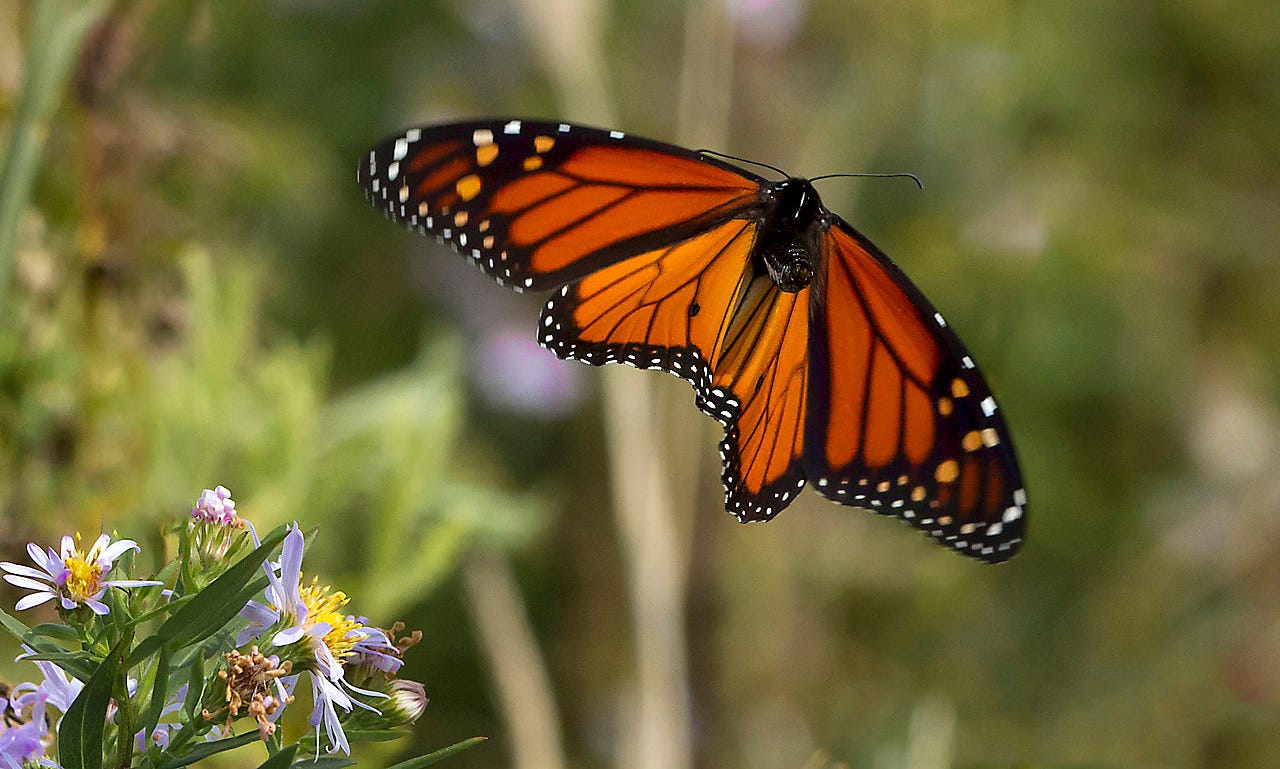
Monarch / © Bryan Pfeiffer

Sadly, but predictably, I think many people might agree with the sentiment “I can’t say that my life would be materially depleted if the Rice’s Whale or other species were to suffer or go extinct” but then, that’s the human condition, right? To assign or not assign value based on the innate belief in our rights/needs above all other beings on the planet. Maybe value isn’t the point. Maybe simply being a piece of the puzzle (ant, human, eel, whale, fungi, whatever) is the big picture point. Thank you for sharing this. I’m sharing it everywhere I can.
All the extinctions. All the losses. All the angst.
Being unaware is no excuse. We are all responsible.
I track local extinctions where I live. So much loss. I started a property list in 1980: Moths & butterflies, birds & spring ephemerals, and more.
Many of these species no longer brighten my day as I walk my trails.
I have protected this place from development, created a management plan, all to provide a refuge within this landscape.
Actions beyond the manager of this parcel will continue to impact diversity here. We each do what we can to protect, but the winds of change are selfish today.
What will tomorrow bring? We can't give up. Your actions, your refuge for diversity may be what makes a difference.
Thank you Bryan, for reminding me.