The Moth and the Flame
Like no other animals, moths bring to your doorstep the extreme and sublime diversity of life on Earth. So lose some sleep with them this summer.
THEIR GIVEN NAMES evoke the breadth of the human experience, everything from virtue to betrayal, beauty to bird shit, the carnal to the spiritual: Splendid Dagger, Chocolate Prominent, Skunk Twirler, Abrupt Brother, Little Devil, Intractable Quaker, Beautiful Wood-Nymph, Owl-eyed Bird-Dropping, The Infant, The Hebrew, The Betrothed, The Drinker, The Penitent. These are but a tiny fraction of the moths that fly near you.
And yet beyond the drama they might invoke, beyond the whimsy of biologists who name them, moths offer us something even more profound: Like no other organisms, they bring nature’s shocking and incomprehensible diversity to our doorstep. By day and night, in the theater of our own backyards, moths embody a spectacle no less monumental than the story of life on Earth.
That’s a bold assertion. So let us begin by dispensing with moths’ general reputation as pests or drab creatures of the night. Ornate as any other insects, including butterflies, plenty of moths also fly by day. Some are no bigger than a grain of rice, others the size of your palm. They twinkle gold and silver and glow hot pink, metallic blue, and 50 shades of brown. They are the epitome of diversity.
And yet even among those of us who study it, biodiversity is somewhat an abstraction. We’re still not sure how many living things inhabit the planet. One widely cited study puts the total at 8.7 million species, with only about 1.2 million to 2 million of them described and named and known to science. So much life remains vita incognita.
How might any of us fathom such variety? Birds get lots of attention. Even so, a birdwatcher in North America would need to be searching almost every day for a year, logging many thousands of highway and air miles, to encounter 700 or so bird species. We have photographed more than 700 moths species alone in my home city of Montpelier, Vermont.
Plants aren’t as elusive. A botanist might need a few casual years and many miles to see and identify, say, 1,000 plant species in most states. And yet the lepidopterist JoAnne Russo has documented more than 1,000 moth species at and around her home in the small town of Rockingham, Vermont.
You need not be an expert like JoAnne to discover moths. Odds are that if there are trees near you, then spectacular moths live there as well. On any give night in the next couple of weeks, many of us living in leafy temperate zones might encounter 100 or more moths species on the wing. (I’ll get to how to find them in a minute.)
To be sure, other insects are more diverse than moths, including flies, wasps, and beetles. The English polymath J.B.S. Haldane, asked to speculate on the composition of the universe, is reported to have said that if the cosmos were divine in origin, the Creator had “an inordinate fondness for stars and beetles.”
And yet we must venture out to meet the beetles and other insects. They do not visit us in multitudes, not nearly like moths, which have an inordinate fondness for light. During National Moth Week, which runs from July 22-30 this year, scientists and other curious people around the world are now beckoning moths to their lights — to enjoy and study them and to learn more about how we’re losing them, among other insects, in the extinction crisis.
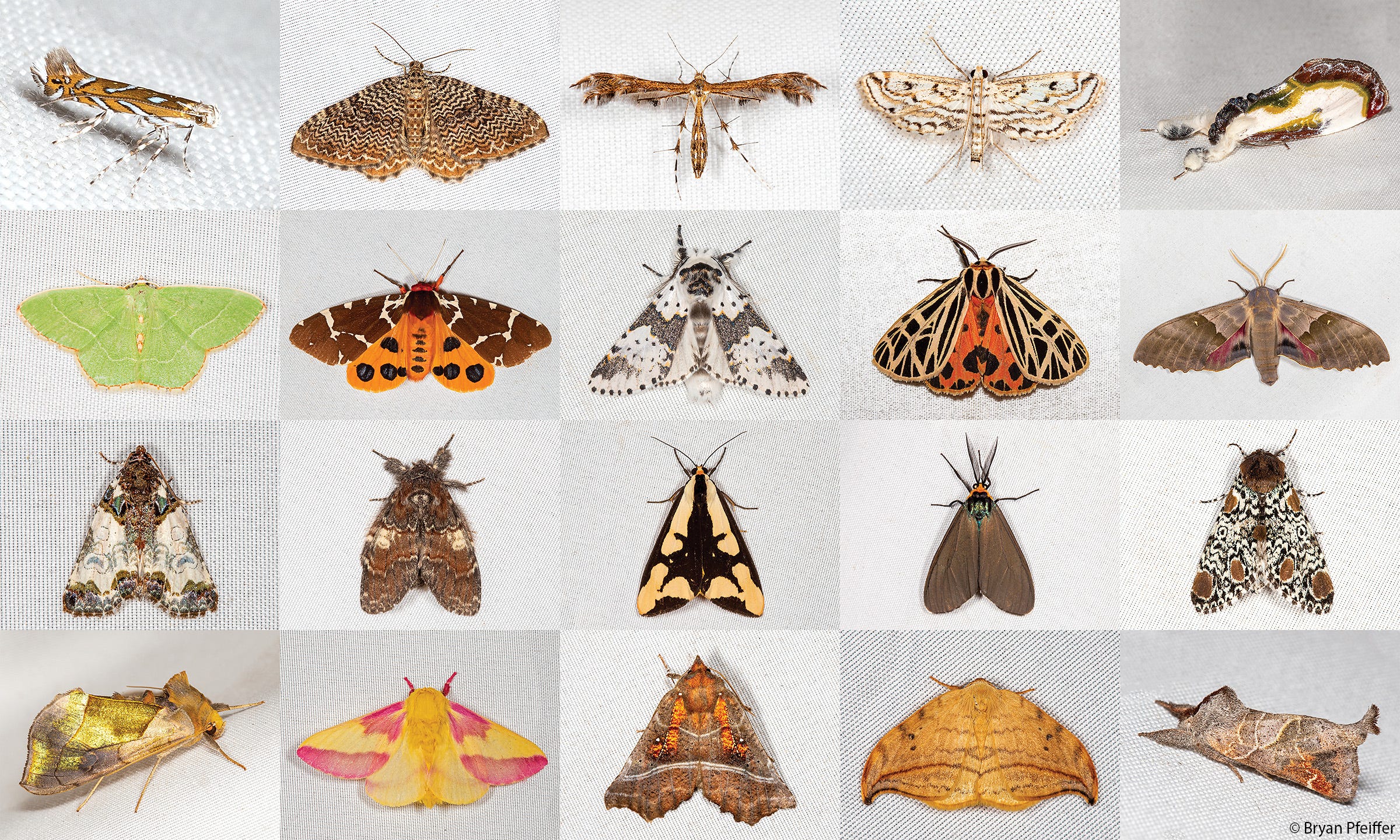
During my own week of sleep deprivation last year, I photographed more than 130 different moth species drawn to my backyard, a sampling of which is represented in that montage above (yeah, those are from a city). Clymene Moth (Haploa clymene) is marked like a flying Rorschach test; Hologram Moth (Diachrysia balluca) does indeed cast an ethereal glow; The Herald flies early to welcome spring, and its scientific name Scoliopteryx libatrix might be a decent title for a heavy-metal band; Tufted Bird-Dropping Moth (Cerma cerintha) is a lovely tapestry despite its name; and with bold streaks and polka-dots, Great Tiger Moth (Arctia caja) resembles a moth cartoon or kid’s toy.
If You Light It They Will Come
Unlike any other wildlife, moths come to us in shocking numbers and diversity by way of our lights (and we’re still not entirely sure why). Ultraviolet or mercury vapor lights are best for attracting moths, but your porch light also works. (For a while, I used to collect those UV “bug zappers” and disconnect the death wires.) The moths usually start arriving an hour or more after dark (so be patient and lose some sleep). Many of us who run more serious moth-lighting stations hang a white sheet so that the moths land on a clean background for photography.
I should point out here that light is a form of pollution. In this case, it diverts moths from their usual nighttime affairs, which is mostly reproduction. So running a moth light comes with responsibility on your part: enjoy and report what flies in, and then turn off the lights so that your moths will go on about their business. (But also recognize that this kind of occasional lighting for moth study is minuscule compared to city and even rural lights ablaze every night.)
To share with the world the moths you find use iNaturalist, which is arguably the most important crowd-sourced repository of biological data anywhere. Basically, you upload your moth photos — or photos of anything living. If you cannot identify what you’ve got (moths can be tough), iNaturalist will do it for you by way of artificial intelligence or by actual human beings — experts who navigate iNaturalist on species identification sprees. We’re often pleased and surprised when novice naturalists unwittingly submit photos of something rare or never previously seen in a particular state or nation. It has happened here in Vermont. It could happen to you.
But even if it does not, perhaps you’ll find the uncommon and amazing Owl-eyed Bird-dropping Moth (Cerma cora), pictured below on a leaf and among lichen and actual bird crap. Or maybe Orange-headed Epicallima (Epicallima argenticinctella), which is a fireworks display packed into a centimeter. You’re likely to see one the grass-veneers in the genus Crambus, looking like a golden-glittery, skinny rice puff with endearing eyes. So do not overlook the tiny specks that come to your lights (massively enlarged in the my two images below the actual and fake bird droppings).

Looking back on all these crazy moths, I like to read their names aloud. My recitation amounts to a kind of sonnet or prayer to something greater than the insects themselves — a tribute to biodiversity, which is wilder and so much older than we are. That diversity is a chapter in the monumental story of life on Earth.
Most of us will never see the shocking variety of the Great Barrier Reef. No birds of paradise or tropical orchids will leave their rainforests to visit us in our backyards or city centers. But moths, living not too far away, even in our most unnatural of places, bring to us a world great and varied and wonderful — and so undeserving of the mess we have made of it.
Giacomo Casanova is supposedly the person who once said, “Be the flame, not the moth.” I say, “Be the flame and the moth.”
All you need to do is leave a light on for them.
Postscripts and Bonus Caterpillar Images
Moths on the wing are mostly out for reproduction — a brief fling for them. Otherwise, moths and butterflies pass most of their lives as caterpillars eating plants. Until I write about caterpillars, I bring you two moth species — adult and caterpillar. Spiny Oak-Slug Moth (Euclea delphinii) is ornate enough as an adult, but festive and spiny (and tiny) as a caterpillar. Brown-hooded Owlet (Cucullia convexipennis) is “woody” as an adult, but like painted porcelain as a caterpillar.
The New Yorker’s Elizabeth Kolbert this year profiled the amazing lepidopterist (and caterpillar diety) David Wagner in “The Little-Known World of Caterpillars.”
Here in North America, your best bet for moth field guides would be the Peterson’s series (Northeast and Southeast editions) by David Beadle and Seabrooke Leckie.
For a sense of moths drawn to ultraviolet and mercury vapor lighting, have a look at this gallery of moth observation from the folks at National Moth Week (but scroll down for the best images).
Finally, moths in the banner montage above (left to right), some of which, because I’m no expert, I identify only to genus level:
Top Row: A leaf miner (Parectopa or Acrocercops species), a Geina plume moth, Watermilfoil Leafcutter (Parapoynx allionealis), a Rheumaptera species, Beautiful Wood-Nymph (Eudryas grata).
Second Row: Red-Fringed Emerald (Nemoria bistriaria), Garden Tiger Moth (Arctia caja), Furcula species, Virgin Tiger Moth (Apantesis virgo), Modest Sphinx (Pachysphinx modesta).
Third Row: Tufted Bird-Dropping Moth (Cerma cerintha), Chocolate Prominant (Peridea ferruginea), Clymene Moth (Haploa clymene), Virginia Ctentucha (Ctenucha virginica), Harris’s Three-Spot (Harrisimemna trisignata).
Bottom Row: Hologram Moth (Diachrysia balluca), Rosy Maple Moth (Dryocampa rubicunda), The Herald (Scoliopteryx libatrix), Arched Hooktip (Drepana arcuata), Apical Prominent (Clostera apicalis).


Thanks for that great essay on moths Bryan. I purposely plant in my garden the tall and fragrant variety of white flowering tobacco because it attracts sphinx moths to it shortly after sunset, which is a spectacle to behold!
I started this year in March, after firing up a light for moth week last year. Last year I logged roughly 140 species using iNat. I reached 125 species last night, and this year I’m keeping a database including larval hosts and basic phenology. The diversity is astounding, and their essential existence to a diverse ecosystem is priceless. That’s my takeaway, and my soapbox. Thank you for this!