

This is the third in a trilogy of essays about life falling to earth in autumn. Links to the others are below.
THE mushroom is slender and diminutive. From its rightful place on a mossy carpet in evergreen woods, it wouldn’t be too much of a stretch to say that the mushroom displays a certain elegance and dignity.
The songbird, well, it’s somewhat unruly and plain by comparison. Hey, sorry, not every imperiled bird can be colorful and melodious, not even an iconic songbird in trouble on a warming planet.
But before I can reveal for you the charm and meaning in the mushroom and the songbird, before I can complete their story, you’ll want to know something about the gentle rain of conifer needles. It’s happening now.
Don’t let anyone fool you about the pines, spruces, firs, and other evergreen trees. Like the vivid leaves of maple and poplar and oak, a good number of conifer needles do indeed fall to earth each autumn. I discovered this decades ago on a breezy day in October here in Vermont. While seated and minding my own business beneath a Balsam Fir, I received a steady sprinkling of its needles. They fell like dry and delicate raindrops, landing on and around me in audible ticks, taps, and tidicks. The episode became for me yet another way to be aware in the good company of a tree.
The Mushroom
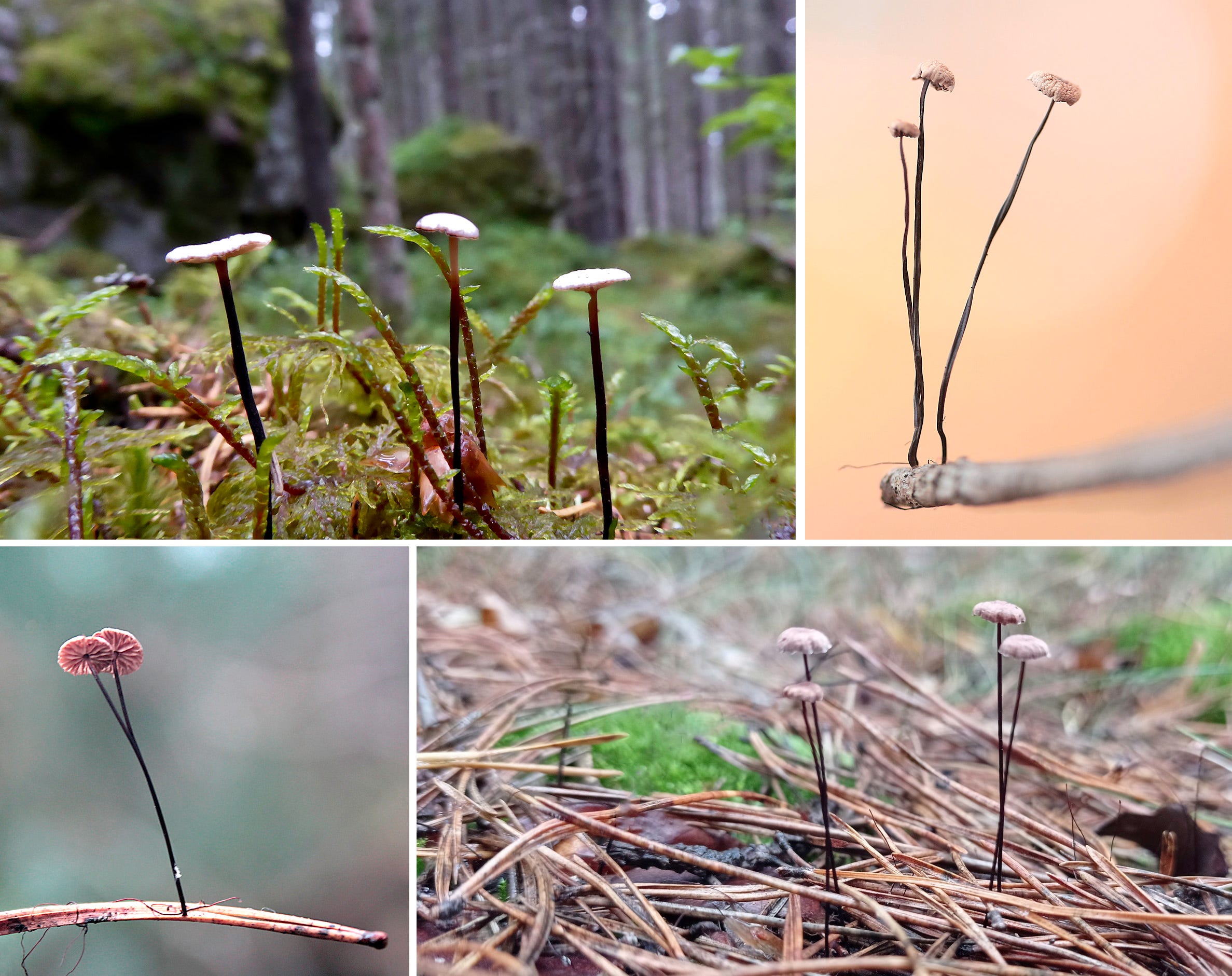
At the time I had also developed an interest in fungi. And during a walk around a pond, I came upon on a tiny mushroom sporting a pale, parasol cap atop a slender, ebony stalk. Although I might have easily and unwittingly stepped on this mushroom, for whatever reason I reached down and unearthed it along with a pinch of the humus and soil from which it had sprouted.
Leafing through the pages of my field guide, I found a match: Horsehair Fungus (Gymnopus androsaceus). My guidebook informed me that the mushroom can grow from a fallen conifer needle or from other bits of woody debris. So I carefully broke away the clump of earth to reveal that this little mushroom was indeed growing from the tip of a single Red Spruce needle. “Wow, cool!” I said to myself, and proceeded on my way around the pond.
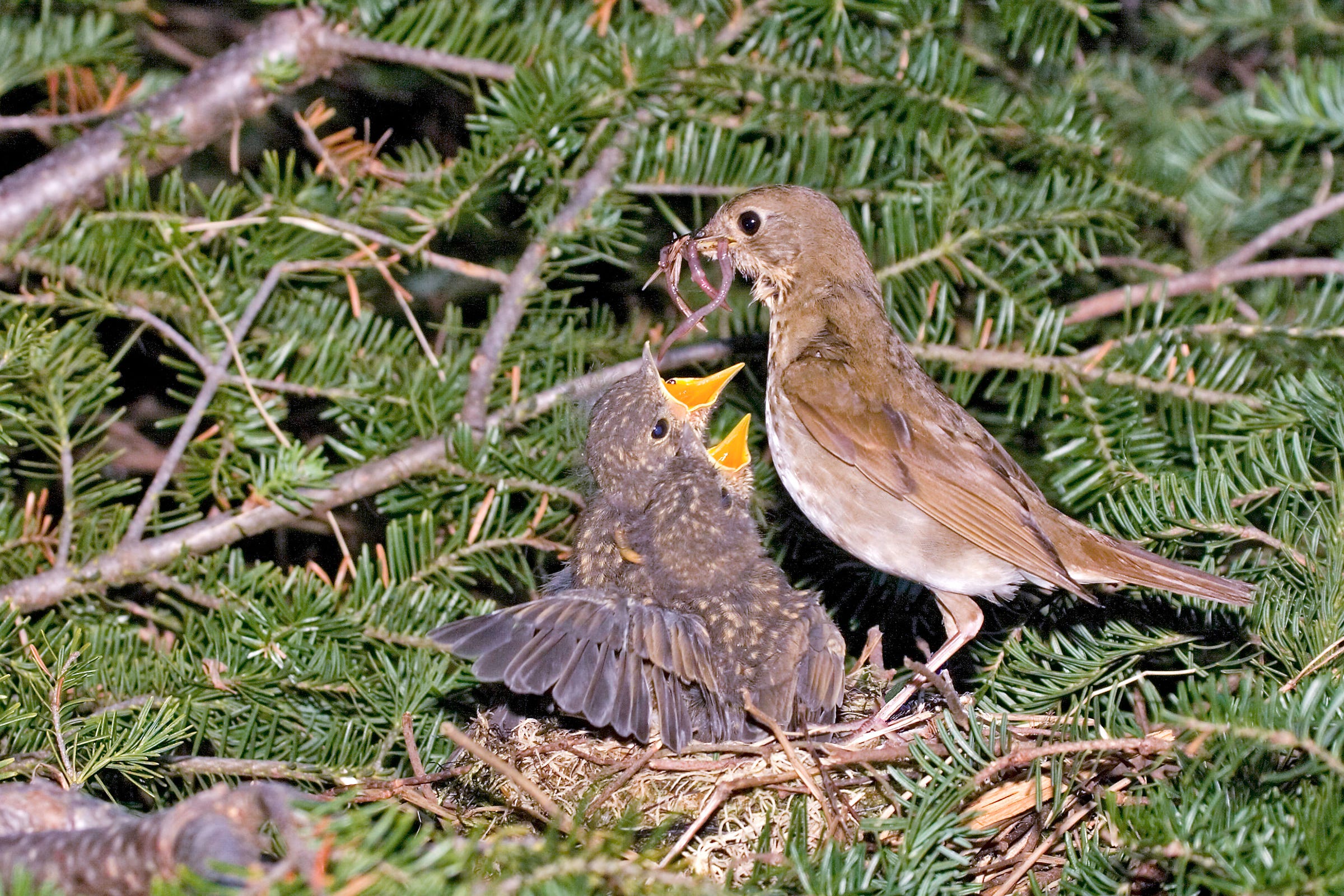
Then I pretty much forgot about Horsehair Fungus — until some years later when I stumbled upon a scientific paper about one of the rarest and most vulnerable nesting songbirds in North America. Although most of you have probably never heard of this bird, it is a classic avian victim of humanity’s all-too-routine assault on nature, made worse by global warming.
The Songbird
Brown and speckled, the Bicknell’s Thrush breeds on remote mountaintops scattered across northern New York, Vermont, New Hampshire, and Maine in the U.S., and in remote forests of Quebec, New Brunswick, and Nova Scotia in eastern Canada. Now that the breeding season has ended, the thrushes are migrating to their wintering grounds in the Greater Antilles, including Cuba, Jamaica, Puerto Rico, Haiti, and the Dominican Republic.
This might not be a bad lifestyle for many humans: summers in the north woods, winters in the Caribbean. But the Bicknell’s Thrush (Catharus bicknelli), intrinsically scarce, faces peril everywhere it flies, including on its migration route. What’s left of the population is declining and its range is contracting in the U.S., and almost certainly so in Canada as well. As a result, springtime in the north is now a springtime depleted — no longer as rich in the swirling song, flight displays, and unusual polyamorous mating habits of this rare thrush.
My intent here is not to dwell on the litany of abuses humans perpetrate on this unwitting thrush, other than to illustrate how easy is it for any of us to endanger a remote songbird that we ourselves may never encounter. The harm comes in the forest products we use, the sugar and avocados we eat, the mercury floating around our atmosphere, and in the electricity and heat we generate by burning fossil fuels.
But before returning to our little mushroom, I will of course reveal a bit about the thrush’s promiscuity. Forget for the moment the notion of a male songbird establishing a well-defined territory where he mates with a female and they raise a brood of young together. Among Bicknell’s Thrushes, the female instead establishes her own territory where multiple males come to visit and mate with her. Although I’m generalizing, male Bicknell’s Thrushes are basically landless nomads competing for copulations with multiple females on their respective territories. As a result, a given brood of Bicknell’s Thrush chicks is often fathered by at least two males.
Females do benefit from this rare breeding strategy (termed female-defense polygynandry). After mating, males aren’t exactly deadbeat dads. They return to various nests to help feed chicks, even though they cannot know how many chicks (if any) in a given nest are theirs. In any event, the females, especially when food for her young is scarce, presumably benefit from multiple males being around to help feed her offspring.
A Convergence
While conducting research on the state’s tallest peak, Mt. Mansfield, a team of ornithologists with the Vermont Center for Ecostudies (VCE) noticed that Bicknell’s Thrushes routinely lined their nests with some unknown root-like strands. Biologists studying the birds in the 1930s had also noted the strands, but never determined what they were. The VCE researchers did (McFarland 1996).
As it turns out, one of our rarest and most imperiled songbirds, offering us so much and asking so little in return, lines its nest with material from a diminutive and elegant mushroom that grows from conifer needles: Horsehair Fungus. Why? Who knows? Perhaps the mushroom strands — rootlike components of the fungus called rhizomorphs — have antibacterial properties. Maybe they’re nothing more than an abundant and available material that makes for a suitable nest lining. I myself need no explanation.
As I write, the last Bicknell’s Thrushes are leaving those nests behind for the Caribbean. I can now envision one of them, before embarking on the trip, landing momentarily on the bough of a Balsam Fir. One of its needles then flutters to earth. From that needle next year there will grow a tiny mushroom — only to be snatched up in the beak of yet another Bicknell’s Thrush building her nest and beckoning males.
Everything in nature is connected, everything matters: my baptism of fir needles, a chance encounter with a little mushroom, a vulnerable songbird, an evergreen tree.
And even one of its needles falling ever so gently to earth.
The Other Essays in this Trilogy


Postscripts and References
Among the most proximate threats to Bicknell’s Thrush:
Clearing and burning for agriculture of mountainous broadleaf forests in critical wintering habitat in the Dominican Republic and Haiti.
Mountaintop development and timber practices on the breeding grounds, especially in Canada.
Global warming, most notably causing the loss of essential spruce-fir breeding habitat in North America (replaced by broadleaf forest).
Our knowledge of Bicknell’s Thrush ecology comes in large part from decades of field research in North America and in the Greater Antilles, often under difficult conditions, carried out by my colleagues at the Vermont Center for Ecostudies. In the video above, by Kent McFarland, those colored leg bands allow VCE researchers to recognize individual thrushes. Before it leaves, the thrush picks up one of the chick’s fecal sacs.
VCE’s Bicknell’s Thrush summary account and the songbird’s International Conservation Action Plan.
Horsehair Fungus image credits (clockwise): Bryan Pfeiffer, Frederik Rothe, Oleg, Erwin Sieben — all available under public license (CC BY-NC 4.0).
For more views of this charming mushroom, here’s an iNaturalist gallery.
McFarland, K. P., and C. C. Rimmer. 1996. Horsehair fungus, Marasmius androsaceus, used as nest lining by birds of the subalpine/spruce-fir community in the northeastern United States. Canadian Field-Naturalist 110(3): 541-543.

Thank you Bryan! I enjoyed learning about the horsehair fungus and its connection to the Bicknell's thrushes. Also the video was great, especially since I did a few of the VCE Mountain Birdwatch surveys and never encountered that elusive songbird.
So beautiful and intricate...
And now to understand how the fungus comes to be on single needles. They must start their life cycle while the needle is on its tree, yes? And then the reproductive parts grow once the needle is on the ground?
We don't have Balsam Firs where we live, but the downed needles in the photos appear to be Eastern White Pine. We have those aplenty, and I've been watching as some of their needles are yellowing in preparation to be abscissed (it was fascinating to learn that abscission is an active process, not a passive one). Time to go look for Horsehair fruiting bodies. Thanks for expanding our fungal knowledge.
And one more thing -- you go, polygynadrous girls! This seems like an exceptionally good reproductive strategy...