
When the Sublime Went Digital
Let's reserve awe and reverence for art and nature — not big tech

Prologue: At its core, this essay is about how any of us might navigate the machinery of technology so that we can preserve our place in a more genuine and natural world. My trigger for this one is a spit-up-your-coffee essay in The New Yorker.
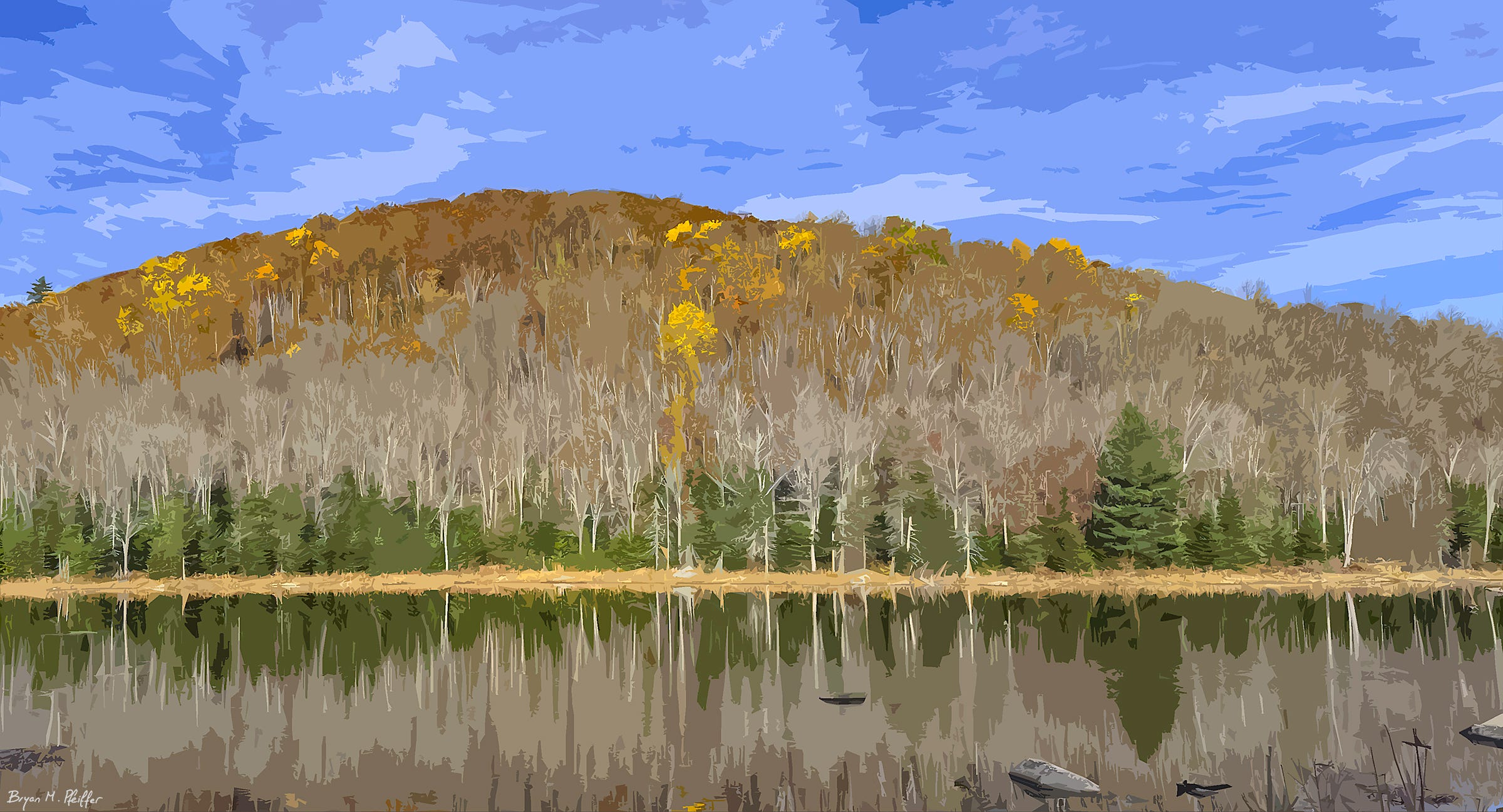
NOW that most of the autumn leaves have dropped, we’re on our way to “stick season” here in Vermont. That’s what we call the month or so—falling between the end of radiant foliage and the onset of winter—when our forests become naked and drab. Gone are the blazing maples and busloads of tourists. Vermont for the time being is a liminal season in fifty shades of earth—and yet a season of something greater still.
Scattered across the muted landscape, and catching the angled light of November, holdout leaves of Quaking Aspen glow yellow and tremble in unison in chilly winds. Long past peak foliage, Vermont’s hillsides remain nonetheless sublime.
That a golden tree or even a single leaf can be sublime comes as no surprise, especially here in New England where Thoreau and other thinkers brought us close to and beyond the beauty and meaning of the natural world. But the sublime resides as well in technology. Or so argues Joshua Rothman in his October 21 New Yorker essay titled “Should We Look on New Technologies with Awe and Dread?”1 Unfortunately, Rothman can’t seem to decide. Tech might subsume us, he writes, but like the sublime to be found in nature, we cannot turn away from the “technological sublime.”
Like thinkers before him, Rothman defines the technological sublime as “the feeling of awe, braided with dread, that can emerge in response to the engulfing possibilities of technology’s progress.” He begins with examples of the sublime in science fiction: the “sprawling cyber-cityscapes of ‘Blade Runner,’” the “cascading green code of ‘The Matrix,’” or even the “uncannily beautiful android” Ava in the film “Ex Machina.” In all of this there’s a “promise of revelation” or “some idea of what it might mean to be more than human.”
Sure enough, these are fantasies of an “as-yet-unrealized future,” but Rothman goes on to assert that the technological sublime does indeed exist in the real world: for decades in the upsweeping ambition expressed in Lower Manhattan’s skyscrapers, more recently in the spectacle of SpaceX rocket flights, and yet more to come in artificial intelligence’s blend of promise and fear.
But are these sublime? Do they warrant from us awe, reverence, or respect? Here Rothman guides us outdoors—and then goes astray. It’s one thing to experience the sublime in a poem or a flower, but Rothman turns instead to 18th-century conservative philosopher Edmund Burke’s alternative sublime in nature—the vast, indifferent, terrible beauty that can kill us: storms, oceans, darkness, deserts. This kind of sublime, Burke wrote, is “not pleasure, but a sort of delightful horror, a sort of tranquility tinged with terror.” So it is with the dangers posed by tech, including AI, whose researchers work in reverence for what they’re creating. “The fact that they aren’t entirely in control of these systems,” Rothman writes, “seems to heighten their sense of being in the presence of something sublime.”
This is a dreadful analogy based on an outdated idea.
It’s long past time to rid ourselves of Burke’s beautiful and terrible sublime, which is a disservice to awe and to what’s left of nature. Invoking it in our relationship to big tech only makes us its cowardly, willing, and disembodied subjects. Not only an affront to the human capacity for wonder, it’s an affront to the idea of the sublime in nature. It’s almost as if Rothman is warning us of the dangers while standing in line for his place in The Matrix.
Burke’s terrible sublime belongs to an era when existential threats were man and god and nature. We’re now more likely to die by nuke, pandemic, or AI than by a desert, ocean, or storm. (And I say this as a mountaineer who’s flirted with death, a field biologist who’s worked in storms and deserts and among wasps and snakes, and as a tree-hugger who knows beauty in nature.) Tech oligarchs and what they’re foisting upon us are not gods unless we make them so.
Rothman and other worthy thinkers might instead scrutinize tech’s almighty patron: capitalism. For better and for worse, capitalism has delivered to us sugar, cotton, and coffee; beef, poultry, and fish; trucks, iPhones, and algorithms. It’s done so for centuries by securing human labor (beginning with slavery) and abusing the planet by way of deforestation, extraction, overuse, deregulation, and technology. If anything in the culture is terribly sublime, it is capitalism’s ascendancy and versatility. And now capitalism has yet another commodity, a new frontier: the human mind. Its drill-rig is the glowing screen.
Before the internet, we used to say that television rots your brain. Kids used to go outside to play—now they go online. And if we’ve learned anything from the data fusillade now unleashed upon us, it is that more information is not necessarily better information. The 24-hour news cycle, the infinite scroll, and the surveillance economy haven’t exactly become fountainheads of candor and veracity. Look no further than the state of public discourse, elections, and governance.
Rothman certainly knows the perils. In closing his essay, he directs us toward the natural world, but ends with equivocation:
At some point, you have to flee from the oncoming wave. You have to return to yourself—to remember, and embrace, the fact that you’re a particular person with agency, obligations, and values. In the natural world, returning to yourself can be as simple as walking away. But, in the technological one, it’s more complicated, because we’re in charge of the pace of exploration, discovery, and invention. Technologists can, to some degree, conjure the technological sublime, and consumers of technology can become addicted to it. But the path to responsibility leads through disenchantment.
Disenchantment or not, I see no easy path to walking away from tech. I myself write on a laptop, publish on Substack, and use gadgets for field work. In seeking refuge from the technological maelstrom, it too often seems there’s nowhere left to walk.
Except toward beauty, toward the genuine sublime.
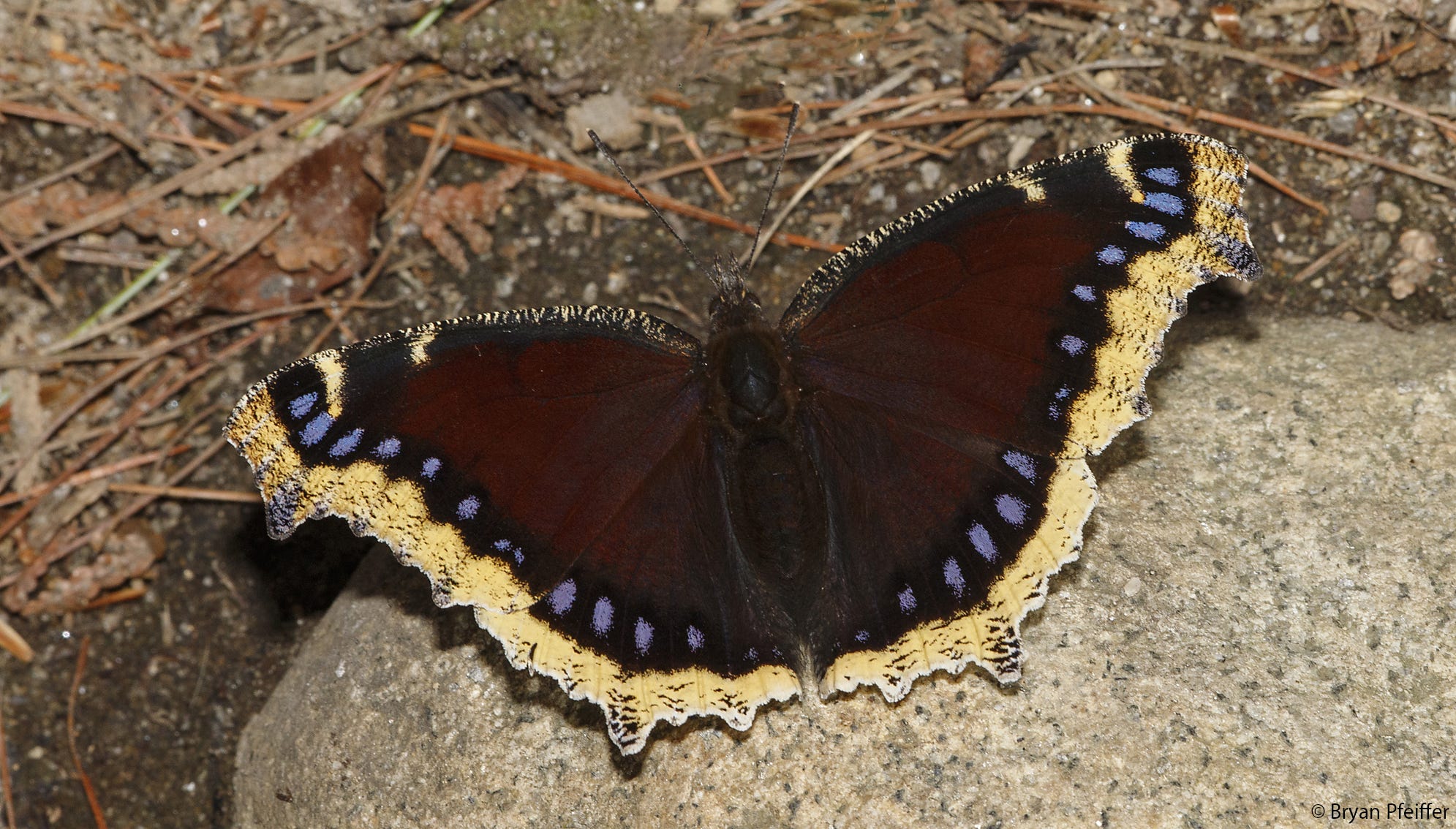
I think and write in nature. For this essay, I wandered not far from home into the gray woods, sat beneath one of those holdout blaze-yellow aspens, and began writing my first draft, as usual, in pencil in my hard-bound notebook. Then came a butterfly, a Mourning Cloak, with chocolate wings edged in butter and studded with blue jewels—a worthy distraction from writing.
But the Mourning Cloak also does something unusual for a butterfly: It survives winter not as egg, caterpillar, or chrysalis, but rather as an adult. Soon enough this butterfly will tuck itself into a slot beneath tree bark or some other cavity, wait out the freeze of winter, and then rouse to fly and mate in the sunshine next spring.
Nature has enough problems—it need not stand in for the perils of tech. Sometimes an existential threat is just that—an existential threat—and there’s nothing sublime or beautiful about it. So let’s leave the sublime where it belongs: art, literature, love, and especially nature. I’ll find mine not online or in the gadgets, but in mountain ranges, beneath golden leaves, or even beside a gossamer butterfly surviving winter in a tree.
The poet Scudder Parker writes of hope in gold:

“Should We Look on New Technologies with Awe and Dread?” by Joshua Rothman.
I so love this description: "Then came a butterfly, a Mourning Cloak, with chocolate wings edged in butter and studded with blue jewels—a worthy distraction from writing."
Although I certainly appreciate much of what tech has brought into my daily life, I'd trade every bit of it for the chance to watch a single crystal of ice forming on the edge of the pond.