I Hear the Tree Buds Singing
In a broken world, find beauty, virtue, and the future on a twig
SOME advice for winter: Dress in layers, watch the wind chill, and notice the bud. Far more than an inert bump on a twig, a bud is a compressed expression of time and space, of songbirds in treetops, butterflies in gardens, and bears in a forest.
When it opens and unfurls in spring, the bud is a Big Bang giving rise to an expanding universe of life and experience in nature. So much potential in each bud, so much promise — we too often pass it by. Someone who did not was Emily Dickinson, who wrote: “How soft the fire of the Bud.”
For me, the soft fire begins with variety, advances to knowledge, and expands profoundly by way of imagination. Yeah, all that from a little bud on its twig. I’ll explain.
First, know simply that a bud contains a plant’s future: a developing flower that has not yet bloomed, a leaf that has not unfurled, or a shoot that has yet to grow. (A bud even houses the tiny inception of yet another bud.) Often enclosed in hardened scales, a bud in winter is a woody plant biding its time until the return of the light and warmth.
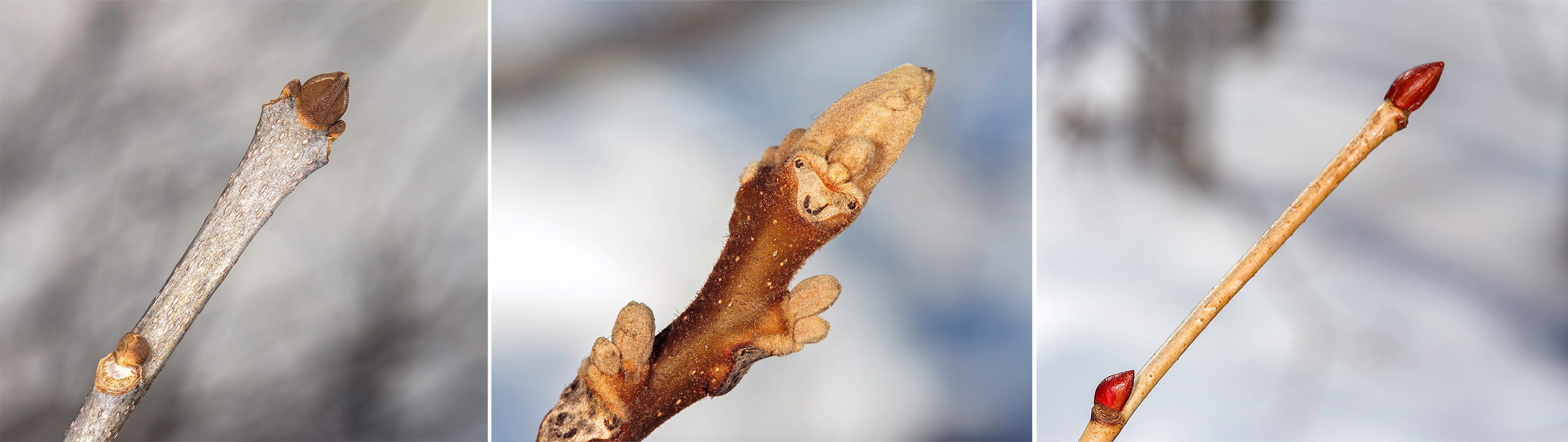
Even if you seek not their brand of philosophy, which I’ll get to soon enough, buds are ornaments on winter trees and shrubs, diverse in form, texture, and tiny detail. Buds can be chubby, slender, hairy, smooth, sharp, aromatic, tinted, comical, even naked (lacking the scales that cover most buds). A hand lens brings you the full experience.
Or should you seek challenge, wintertime tree identification is a thing. Sure, some trees are easy: you can drive-by-identify a leafless sycamore, elm, or sweetgum based on bark, crown shape, or hanging fruits. But bring me a twig bearing a single bud, and I will name for you (most of the time) the species from which it came. By its round, red buds, for example, I know that the barren tree beside the river will be among the first plants to bloom each spring here in Vermont: Silver Maple. Those odd buds with monkey-face leaf scars confirm that I’m in the presence of a Butternut, which is imperiled across much of its range (and pictured above, smiling and waving at you). Slender and elegant with frosty-tipped scales, the bud of American Beech is incontrovertible. So, yes, if you know your buds, you can know plants year-round.

The Little Big Bangs
But on these frigid days, I’ve been looking beyond buds for even greater purpose and meaning. I dream not only of what a bud will become, but all that will come about as a result. Three examples:
From the bud of a maple in May there will unfurl a few leaves, on which a moth named Curve-toothed Geometer will stop by to lay her eggs, which soon hatch into inchworm caterpillars munching away at those leaves. Then to the forest comes a wave of migrating songbirds. But the songbirds cannot eat maple leaves. They feast instead on the caterpillars, which they will feed to their nestlings as well. So, a bud becomes a leaf, which becomes food for a caterpillar, which becomes food for a warbler and its offspring. The buds of maples now sing me a dawn chorus.
From the buds of the lilac in your garden there will emerge showy blooms in spring. If their color and aroma aren’t enough joy for you, share them with tiger swallowtail butterflies that flutter and flash and sip lilac nectar into summer. A bud becomes a flower, which feeds an insect. The buds of a lilac now float in winter on gossamer wings.
From the bud of an American Beech there will emerge flowers that dangle from their twigs like little chandeliers. The vernal breezes will blow pollen from male flower to female. And the fruit of that event will become a beech nut, which feeds the black bear before hibernation in autumn. The bud of a beech embodies a slumbering bear.

I recognize that I’m asking a lot of winter buds — or at least expecting a lot from them. Then again, it’s not really up to the buds. They’re buds being buds; I can’t know half of what’s going on inside of them. No, this is instead about me, what I choose to notice and how I envision the future.
Plants have been resting and expanding by way of their buds for hundreds of millions of years, which is hundreds of millions of years longer than we’ve been around making a mess of things on Planet Earth. Nope, buds won’t solve our problems — not by a long-shot. But on the most painfully frigid of winter days, as I fret about lies and injustice perpetrated from Minnesota to Sudan, from the Amazon to the Congo, a bud on a twig offers me a bit of stability and notions of springtime yet ahead.
So, yeah, I’m asking a lot of buds. I suspect they’re up to the task. After all, buds hold a plant’s future in trust. I trust them to hold a share of my faith and future as well.
Postscript: This Bud’s For You
If you have a hand lens, the capacity to be outside, and some imagination, you have what it takes to discover the little singularities known as buds. For Chasing Nature’s paying subscribers, I’ve included a few tips and resources on our Sightings page at the Go Wild portal. Paying subscribers also have access to my tribute and buyer’s guide to hand lenses, to one of my most cherished (and ever relevant) essays titled “Lies and Light,” and to another titled “The Eroticism and Mythology of the Naked Bud.” Onward!


Such good writing! I enjoy your work and admire it and am glad to support your Substack. Thanks for the special resources for paid subscribers ~ from which I'm looking forward to learning more about identifying winter buds.
Wonderful! I have just started seeing the buds on our Indian Plum-the first thing in the woods near me to show up!