


On a pleasant summer morning in Vermont’s capital city of Montpelier, the terrain at North Branch Nature Center is teeming with endangered animals: children running wild in nature.
The preschoolers visit a woodland stream to collect rocks, search for salamanders, and compete in “frog olympics.” The older kids head for a forest trail where they’ll explore the mysteries of an old stone wall and a long-abandoned homestead. And a group of children and teens with disabilities, some using wheelchairs, navigate the trails on a guided botany outing.
The nature preserve buzzes with kids in floppy hats and neon-colored Crocs, kids lugging oversized backpacks and snazzy water bottles, and kids running in circles and laughing for no apparent reason other than the joy of being a child in summertime.
And not a phone in sight.
The scene is reminiscent of a time long gone for most adults: when we experienced the world before tech commandeered so much of our time and attention. Anxious psychologists, social scientists, and other thinkers warn us regularly about this shift from what is tangible in the world toward what is delivered to us by way of glowing screens. Even our tech overlords now profess to help us manage the contagion they themselves have unleashed. And this is to say nothing of what will come from AI.
Phones of course get much of the blame for the human drift from plants, animals, and the sublime outdoors. But as a field naturalist who works and plays in nature, and who writes about it, I’ve come to realize that this threat to our well-being is far more tangled and pernicious than phones, social media, and various online distractions. The forces in play in this retreat from the living world, thousands of years in the making, range from the raw power of the free market to the formidable trajectory of human evolution. Except that now the stakes are huge. After all, to defect from nature is to abandon much of what it means to be human.
I do not know to what extent a disembodied life is our destiny, or to what extent we might change course. Nobody knows. I nonetheless have ideas and hope, not as a social scientist or evolutionary biologist, but as a naturalist who finds joy, virtue, and purpose in the natural world, equipped with little more than my senses, some childlike curiosity, and, yeah, an iPhone 15.
The Best of Tech, The Worst of Tech
Before I describe the evolution of this retreat into the screens, and how we might respond to it, an essential point: This is no polemic on technology. I seek not to bury our screens, only to undermine their grip on us. My enthusiasm for adding more nature to our lives also embraces virtues not directly of this Earth: literature, art, music, liberty, genuine conversation, actual community, or even the act of sitting around and doing nothing. I will argue, however, that in the digital age the human bond to nature is imperiled in ways that those other virtues are not.
Long ago, those other virtues didn’t exist. Nature was our only template. No wonder that some of the first known figurative artwork, painted at least 45,000 years ago on cave walls in Indonesia, depicted animals: wild pigs and dwarf buffalos in a hunting scene with human figures. It’s not like our ancestral cave dwellers had Taylor Swift, cat videos, or Jesus Christ to watch, share, or turn into art. Nature was it — we were nature.
But human evolution would of course go on to feature fire, language, warfare, agriculture, music, books, religion, commerce, governance, demagoguery, football, junk food, newspapers, radio, television, and the halcyon days of the internet — all of it competing for our attention. I’ve basically got no quarrel with that. We moved into cities and therefore farther from nature. We no longer needed to hunt our dinners and gather our breakfasts. We listened not for predators, but to radio dramas, live jazz, and audiobooks. We watched not our clan enemies, but The Ed Sullivan Show, soap operas, The Simpsons, Home Shopping Network, The Sopranos, and Substack content.
Before the internet (and before good cable), we baby boomers used to say, “TV rots your brain.” And so it might be convenient to suggest that the brain-rotting now has many new screens, including the one in our pocket. That would be true. And yet my iPhone brings me music, maps for my fieldwork, baseball box scores, texts from friends, a respectable camera, and the weather. Beethoven’s Ninth performed live will change your life; on my phone through good speakers or earbuds, it remains a magnificent symphony. And although I myself prefer not to read news, email, books, or much of anything on my phone, plenty of people do — and it brings them meaning and purpose. So it’s clear that much of what we read or experience in our highly evolved lives — from your personal health data to Heather Cox Richardson — has migrated well to our phones and to other screens.
That’s not the case for nature on little screens, or on big ones. To be sure, nature on a screen can entice and inform us, but it’s nonetheless a special victim of our retreat from the living world. And the reason for this is far more consequential than, say, your inability to smell a rose or catch a firefly with your iPhone. The reason has almost everything to do with the fertile frontier of the human mind.
The Seduction of Our Senses
In their heyday, radio and television were agents of knowledge, entertainment, propaganda, and ultimately commerce. Whether the program was the Grand Ole Opry or Meet the Press, the medium was out to sell us something. And to help merchants know what we liked and disliked, and what we might buy, there was the market research firm known simply as Nielsen.
During much of the 20th century, Nielsen’s mission was to understand the habits of consumers. The company tracked product sales to discover what we liked to buy in drugstores, what radio stations we listened to, what TV shows we watched, and whether we preferred oatmeal or corn flakes. As an instrument of commerce, Nielsen helped businesses understand — and increasingly shape — how we spent our time and money. It was a seed of the algorithm.
By today’s standards, Nielsen’s methods were blunt instruments. Sure, the company installed devices on home televisions and radios that recorded which station was on at any moment. But Nielsen knew little else about a given household’s proclivities, its likes and dislikes, its everyday habits, and secret urges. The Nielsen Surveys and the Nielsen Ratings revealed more about us in the aggregate than as individuals.
It’s all rather quaint and crude compared to Big Tech’s resolute incursion into our minds. In the competition for our money and attention, digital platforms now know too much about us: what we love, what we hate, what we read, our desires, our politics, our impulses, and whatever gives us an online dopamine hit. Instead of relying on a Nielsen telephone survey or a meter attached to our computers and gadgets, Big Tech is hot-wired to our brains. Whatever we click, watch, like, share, skip, search for, or linger over, the algorithms learn more about how to seize and hold our attention, to keep us online and scrolling. Nature doesn’t stand a chance.
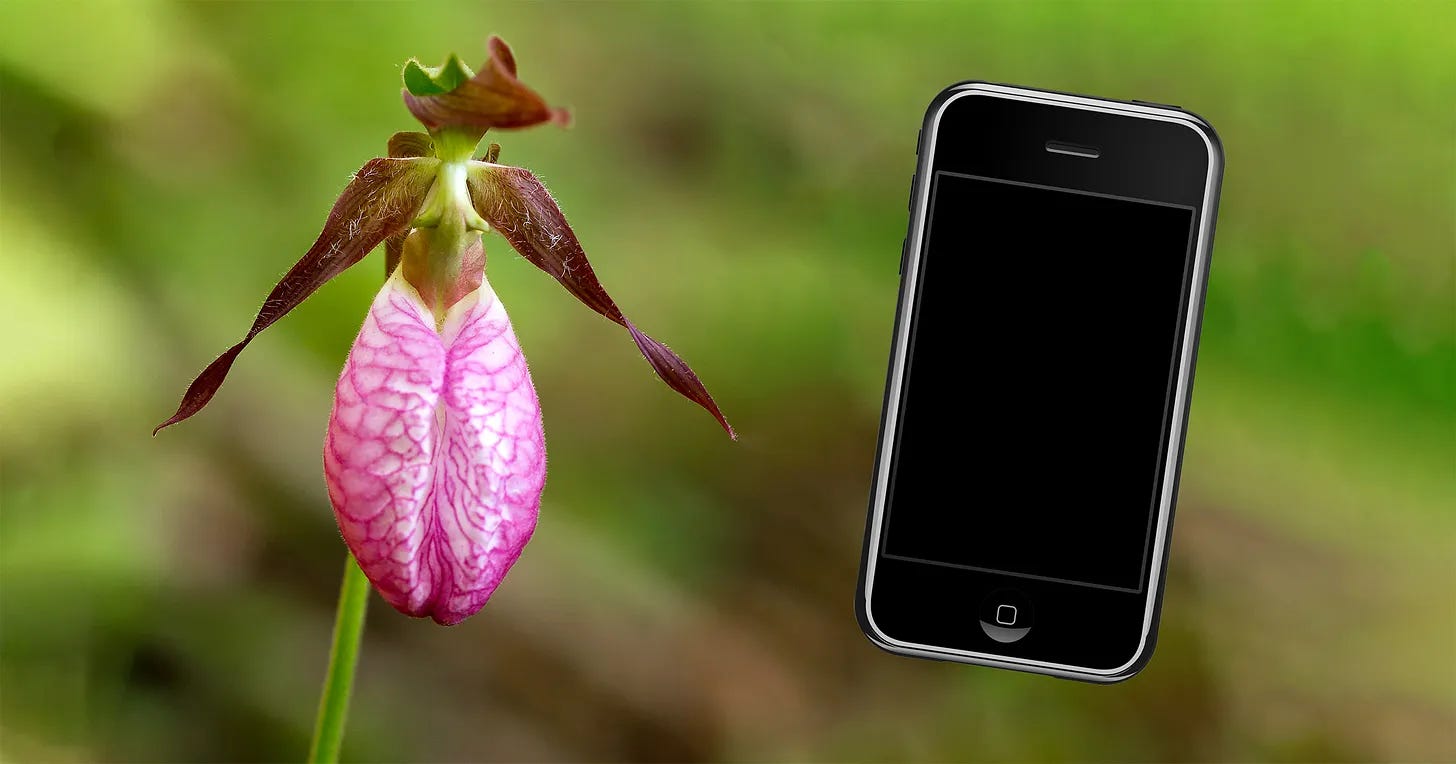
Okay, that’s an overstatement. Nature doesn’t really seek a chance at our attention. Nature doesn’t give a damn about us. It doesn’t want to kill us or court us — it simply exists (except when we kill it). Birds sing not to us, but to one another. Butterflies seek not our affections, but sunlight and mates. An orchid is lovely not to seduce us, but to lure bees and flies and other pollinators. And even if an orchid were specifically evolved to court us, unlike music or poetry, it would never be as seductive on a screen as it is in the wild. Nature online simply isn’t as good as the real thing.
Big Tech doesn’t need an orchid or a sunset to be seductive to us. It only needs to know our minds. Its algorithms appeal not merely to any broad demographic (like the results of Nielsen surveys), but specifically to you as an individual in order to seize your attention and your time. Except that you and I are not pollinators. We are prey. And all too often, we are easy prey.
Earlier this spring, here in Montpelier, when our middle school let out for the day, I noticed a 30-something man in my neighborhood walking away from school with a little girl who I assumed was his daughter. The problem was that he was fixated on his phone while the girl walked 10 feet behind him. Maybe something at work distracted his attention. Perhaps he was reviewing his daughter’s homework for that night. Or maybe he was reading the day’s headlines. Whatever the case, and whatever else causes so many people to turn to their phones while driving, waiting in line, walking the dog, or seated with family in a restaurant, it’s likely that the distraction has little or nothing to do with the natural world. Even allowing for our urban and suburban migration over the past century, nature simply isn’t that important anymore to the people and corporations shaping human culture.
The Relegation of Nature
Our bond with nature was once commensurate with faith, education, the arts, governance, and other pillars of culture and society. That bond is by no means dissolved; I believe it’s still in all of us. And yet nature has become more of a destination or novelty than an integrated facet of what it means to be human. In our drift from nature, the human experience has increasingly become a fusillade of celebrity, demagoguery, commerce, distraction, and other instruments of artifice. We know corporate logos better than the names of trees lining our neighborhoods. Our children spend more time with their phones than with frogs, flowers, fritillaries, or even their friends.
Look around the news. Few major newspapers (The Guardian in the U.K. is a notable exception) have a nature beat with reporters regularly covering the virtues of our encountering animals, plants, fungi, and the wild places around us. When newspapers do bring us the natural world, they tend to report on unusual or imperiled species far afield. That’s fine and essential. But for every 10 articles about the depravities of politicians, the glitter of celebrities, the intricacies of football, or even the virtues of art and books, couldn’t we have just one about when the songbirds are migrating through, why butterflies seem scarce, or where to discover wildflowers close to home? I’ll tell you what: forget one in 10. I’d settle for one article about human experience in nature for every 20 about everything else.
The relegation of nature is evident here at Substack, where I seem to be the platform’s highest-ranked general nature writer. As of late August, I’m ranked 21st in Substack’s Climate & Environment category. All the “bestsellers” above me and most publications ranked below me focus on global warming policy, power generation, public lands, animal justice, weather, or some other worthy niche topic. Plenty of other nature writers publish on Substack, but are somewhat lost in the Climate & Environment category. Substack maintains official categories on Business, Finance, and Crypto, and yet Climate & Environment is basically the platform’s only place for general nature writers.
I cite my ranking not to boast or to gripe — Substack is good for us — but rather to point out that classic nature writing, not about environmental issues, is too often relegated or overlooked in the mass media and other places where people share ideas. I also recognize that this could reflect a sagging level of public interest in nature. Maybe people care more about finance and crypto than birds and butterflies. But maybe that’s because they don’t have as much opportunity to read about the birds and butterflies where they live. To be clear, we humans have not entirely forsaken nature, but it seems to be losing its status in the public square.
Or even in ostensibly loftier places. This past spring, Pope Leo XIV issued his encyclical on artificial intelligence. Titled “Magnifica Humanitas,” which is Latin for the grandeur of humanity, the letter is in large part about the common good, meaningful work, social justice, and individual freedom. Whether or not you abide its references to God, “Magnifica Humanitas” is at its core a document about human dignity. And yet among the encyclical’s 40,000 words (Pope Leo needs better editors), there is little discussion of how our bond with nature is good for the mind, body, and soul — about how it makes us human. Not a word about plants, birds, insects, mountains, forests, meadows, lakes, or streams. Nature as experience, adding grandeur to humanity, gets only passing mentions. (But see my postscript on Laudato Sí.)
The Orchid and Hope
Whatever our faith, all of us have one thing in common: our one home. Climate and environment aren’t issues — they’re where we live. And they’re what we’ve damaged. In the long struggle for existence, humans, corporations, and governments have always exploited two things: nature and people. In the name of growth and prosperity, our cultures have destroyed forests, prairies, and wetlands; pillaged and depleted the seas; and committed unspeakable crimes against one another. Still, we know restraint. We’ve gone on to adopt laws, however late and imperfect, designed to limit pollution, outlaw slavery, and curb abuses of human labor, including child labor.
But exploitation is hardly limited to nature and labor. Big Tech is now coming for our minds. Our time and attention online are its frontiers, its commodities. And in too many ways, we’re defenseless, especially our children. The force of the algorithm turns us away from the embodied life, from genuine experience, from the living world, ever toward the glowing screens. In the middle of a maelstrom, it’s hard to see what’s happening — let alone do something about it. But we can do something about it.
We can apply moral codes and laws to Big Tech’s assault on the sanctity of the human mind. I have little faith in what passes for governance here in the U.S. Therefore my remedies, although no substitute for laws, are personal and close to home, including writing for you here at Chasing Nature. For any of us, it’s as simple as going outside with a field guide and learning a couple of trees in the neighborhood, a few birds in the park, or just one butterfly in the garden. Pause with a child at a flower and explain its miracles. By all means, spend less time with your phone (I’ll write soon on my own strategies). And support any nature center, library, school, or club bringing children and adults closer to the living world.
Among those children running wild at North Branch Nature Center, the orchid has a genuine chance against the algorithm. Seated in the wonderful chaos of children chasing everything from frogs to flowers that morning, I asked one of the center’s teacher-naturalists, Annie Jackson, about her work and her sense of optimism.
“I don’t see kids on their phones all summer long,” she told me. “It restores my hope.”
Postscripts
I am somewhat remiss in not mentioning above “Laudato Sí,” Pope Francis’ 2015 encyclical “on care for our common home,” which is more in tune with the human bond to the natural world. His encyclical covers rampant development, consumerism, environmental destruction, global warming, and our estrangement from nature. “When we speak of the ‘environment’, what we really mean is a relationship existing between nature and the society which lives in it,” Francis wrote. “Nature cannot be regarded as something separate from ourselves or as a mere setting in which we live.” In, “Magnifica Humanitas,” Pope In Leo does indeed reference “Laudata Sí.”
For more on major news media’s flawed coverage of the natural world, here are two critiques I’ve written: one pokes fun at The New York Times and the other takes issue with The New Yorker’s idea of the “digital sublime.”
My gratitude goes to Jason Anthony, who writes Field Guide to the Anthropocene and reviewed a draft of this essay.
More gratitude to Annie Jackson, Ana Maria Arroyo, and the staff at my favorite eco-organization, North Branch Nature Center in Montpelier, Vermont, where I volunteer with friends every Tuesday. You can help NBNC bring people closer to nature by giving to its mission. Or if you subscribe to my mission here at Chasing Nature this month, I’ll donate half your fee to North Branch Nature Center. Thanks!
iPhone image above via Wikimedia Commons and Rafael Fernandez (CC BY-SA 4.0)

How do you read my mind and then write such an essay that brings together my concerns. Those big money folks don't seem to know we need the natural cycles, if broken by their greed, we all pass away. Food, water, air. And nature gives us all of that as well as beauty and a sense of belonging. Thanks again Bryan. There is hope. And community. (tech can help? it does here)
Hi Bryan,
I'll take the beauty of nature any day over tech. We went to a one room school and our teacher brought us into the woods to find Lady Slippers, Bloodroot and Trilliums along with catching some Polliwogs to take care of and the Monarch as well. I passed this onto my students throughout the 43 years I taught 🙂 Thank you and enjoy what you wrote, Pamela